


There can be no energy transition without climate-friendly buildings – that much is clear. Led by the Oldenburg-based affiliated institute OFFIS, a team of researchers from the northwest region has investigated how digital solutions can help advance the “heating transition” (Wärmewende).
“The heating transition is a central pillar of the energy transition,” says Prof. Dr. Sebastian Lehnhoff, member of the executive board of the Oldenburg-based OFFIS Institute for Information Technology and Professor of Energy Informatics at the University of Oldenburg, emphasizing what other experts have repeated again and again: On the path towards a net-zero future, a key objective is to make buildings more energy-efficient and convert heating systems to renewable energy sources.
According to the website of the Federal Environment Agency, operational energy use in buildings accounts for around 35 percent of the total energy consumption and approximately 30 percent of CO₂ emissions in Germany. Progress towards reducing this percentage has been slow – emissions in the buildings sector have actually been stagnating again for some time now.
As speaker for WärmewendeNordwest, a large-scale collaborative project, Lehnhoff has witnessed several technical advances and political shifts in this field over the past five years, the most recent being the German government’s policy document setting out the key points for a new Building Modernization Act. But for Lehnhoff, one thing is certain: “Alongside renovation, digitalization also plays a central role in the heating transition.” And this was precisely what the project team focused on. Comprising around a hundred researchers, the team has developed various digital solutions designed to support those involved in tackling the challenges of the heating transition – from homeowners to local authorities.
The project, which officially came to an end last autumn, was a major undertaking involving five universities including the Universities of Oldenburg and Bremen, eleven companies mainly from the northwest region, among them grid operator EWE NETZ and the Bremen utility swb AG, as well as several non-university research institutes and the City of Oldenburg. The Federal Ministry of Education and Research provided a total of 16 million euros for the project, with an additional three million euros supplied by the project partners from their own funds. Several sub-projects are still ongoing, having been granted an extension of several months to finalize prototypes or compile their findings into scientific papers, guidelines and strategy papers.
As the project progressed, the people working on it saw for themselves how much of a hot-button issue the heating transition is. “Everyone is talking about it,” says Christine Rosinger, coordinator of the overall project at OFFIS. “Time and again, members of the public have approached us wanting to know why the heating transition is at all necessary, whether heat pumps will overload the electricity grid, or whether they will now have to replace their oil-fired heating systems.” To address common questions – about which there is also a good deal of misinformation – the team compiled a detailed FAQ list on the project website.
Digital building files for homeowners
In practice, however, the results of the project are even more useful. The digital tools developed by the researchers can be used at various stages of the heating transition process – starting with homeowners who are considering renovating their properties. For this group, a team led by business informatics specialists Prof. Dr. Jorge Marx Gómez and Sven Lampe from the University of Oldenburg has created a dedicated online platform. Users can enter data and upload photos about their buildings into the system, which creates digital building files on this basis. Users then receive suggestions on which renovation measures make sense, what would cost, and what savings they will bring. “The platform can even connect users with potential contractors in the region, and it also takes funding schemes into account to keep the costs of renovation measures low,” explains Marx Gómez.
The prototype for the platform was tested extensively in the project, for example by master craftsman trainees (Meisterschüler). Homeowners also tried out the tool and received advice on which funding schemes were most suitable for their property, how much they could save, and how long it would take to recoup the costs. The team is currently applying for funding so that it can make the platform, called Upweerten, permanently available online.
Emissions optimization on campus
Another area in the heating transition concerns larger building complexes and industrial facilities that are supplied by various sources and often generate some of the energy they require themselves. “With such ‘multi-energy systems’, it makes sense to consider electricity and heating requirements as a whole, and to optimize them jointly to ensure that both electricity costs and CO2 emissions are reduced,” explains Ekaterina Lesnyak from the University of Oldenburg’s Department of Computing Science.
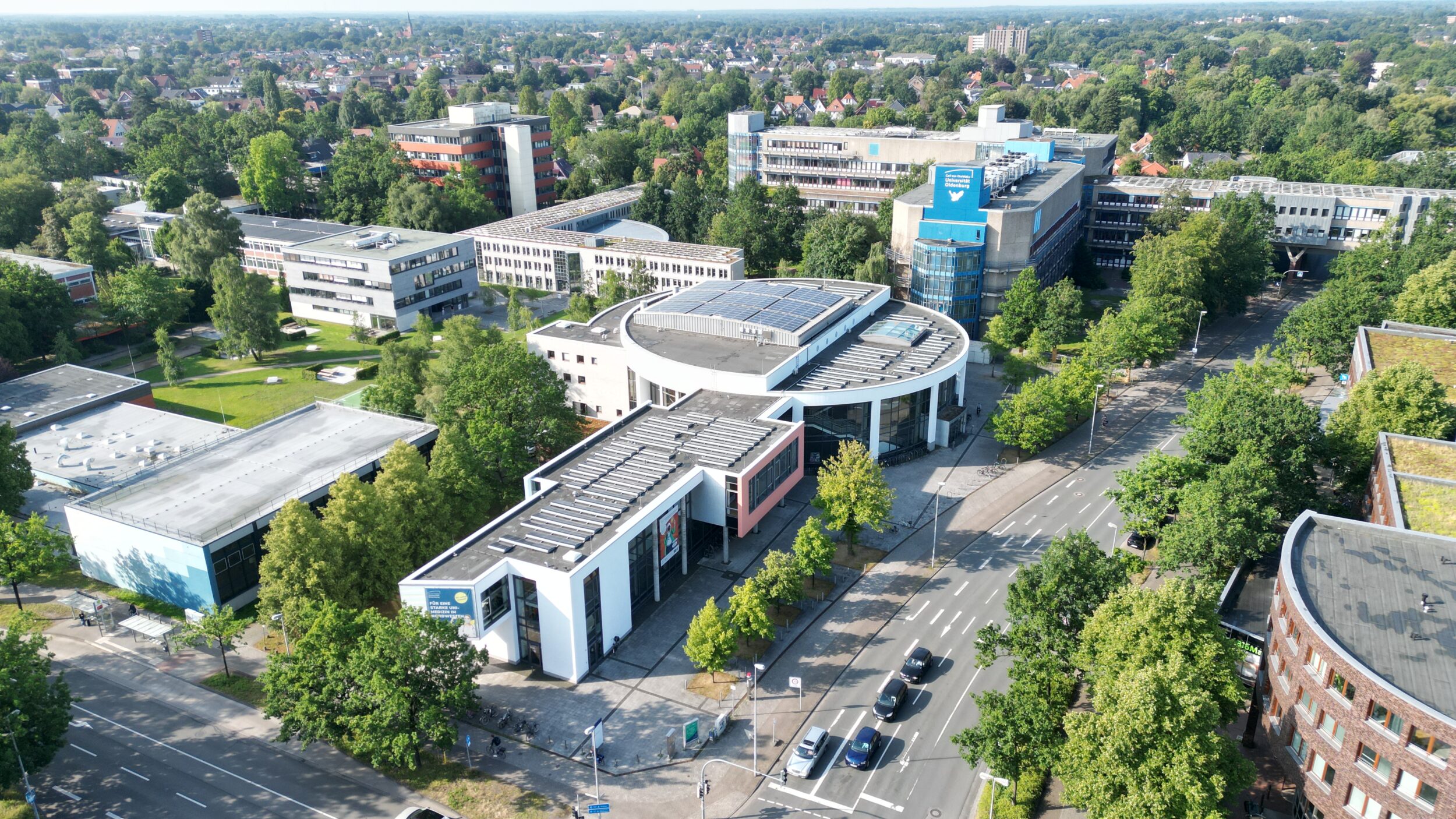
Lesnyak studied an example that was right on her doorstep – the University of Oldenburg campus. Laboratories, data centers and larger buildings not only need to be supplied with electricity and heat via large-scale systems, but also require cooling and ventilation. As a partner in the WärmewendeNordwest project, the university installed three innovative cooling and heating systems in 2024 and 2025: a new ventilation system in the Central Library, an absorption cooling plant on the natural sciences campus, and a system for waste heat recovery in the data centre.
These renovation measures have helped to significantly reduce energy consumption: electricity consumption at the library has dropped by 17 percent, for example, and heating energy consumption by more than 75 percent, with the corresponding reduction in CO₂ emissions. Part of the construction costs for these measures were funded by WärmewendeNordwest, with the university covering the remainder from its own resources.
As Lesnyak discovered by performing simulations, CO₂ emissions could be reduced even further if the three systems were operated via a shared control system. The computer scientist created a “digital twin” of the systems, which she fed with real-world data and trained using machine learning to compare different operating strategies. The result: “Because the university has various options for energy generation at its disposal – combined heat and power plants, PV systems, and heat recovery and electricity from the public grid – there is potential for synergies if the lowest-emission option is used at any given time,” she explains. Emissions from the three systems could be cut by up to ten percent if the building management systems were optimized. This is not yet possible at the university because the current measurement infrastructure is not designed for this purpose. However, Lesnyak’s findings could be applied to other university campuses or industrial facilities.
From campus to neighbourhood
The sustainable heating of residential areas and neighbourhoods is no less complex than the energy-efficient operation of a university. A WärmewendeNordwest sub-project led by the DLR Institute of Networked Energy Systems in Oldenburg examined an example of this in Bremen: the Neu-Schwachhausen district comprises both detached houses and three- to five-storey apartment blocks that date back to the 1960s. “The neighbourhood is very diverse and was therefore well suited to our research objectives,” explains project team member Tino Mitzinger from the Resilient Energy Systems research group at the University of Bremen.
Using computer modelling, the team examined heating options for Neu-Schwachhausen to ensure that the system could withstand any potential problems, from power cuts and extreme weather to technical problems, with as little disruption as possible. “We generated and analyzed more than 500 future scenarios for 2030 and 2050 – including those in which all heat is generated using electricity, as well as those that use hydrogen or synthetic gas,” explains Mitzinger. The main criteria for a resilient system included redundancies, buffer capacities and a certain diversity of energy sources.
Although the end result is not yet clear, the researcher notes: “It has become apparent that storage is extremely important, particularly when electricity is only available at specific times.” At the same time, it is becoming clear that heating based on renewables is the most economical solution. “In the long term, this will definitely be cheaper than continuing to rely on fossil fuels,” emphasizes Mitzinger, pointing to the results of the team’s model calculations. The end product of the sub-project is a digital “tool” which local authorities can use for energy planning based on geodata and modelling.
Transfer in the region
In addition, further findings from the project are now gradually being put into practice. “The City of Oldenburg, for example, has expanded its renewable energy register, developed a renovation plan for municipal buildings and produced a guide on ‘gray energy’ – which refers to the reuse of building materials,” project coordinator Rosinger explains. EWE NETZ investigated how decentralized electrolyzers – electrochemical systems that split water into hydrogen and oxygen using electricity – can be integrated into the energy system and the City of Oldenburg commissioned a legal report on shallow geothermal heating networks, in other words, networks that utilize geothermal energy close to the surface. The project team also organized events for both members of the public and experts, developed new teaching concepts for the skilled trades, and offered further training for master craftsman trainees.
“A strong sense of team spirit developed over the course of the project,” says Christine Rosinger. This was not a given, as some of the sub-projects had quite different focuses. “The important aspect was that we developed a shared vision and everyone worked towards a common goal,” the computer scientist emphasizes. Sebastian Lehnhoff sees WärmewendeNordwest as a success: “The project may be over, but its impact lives on.”