
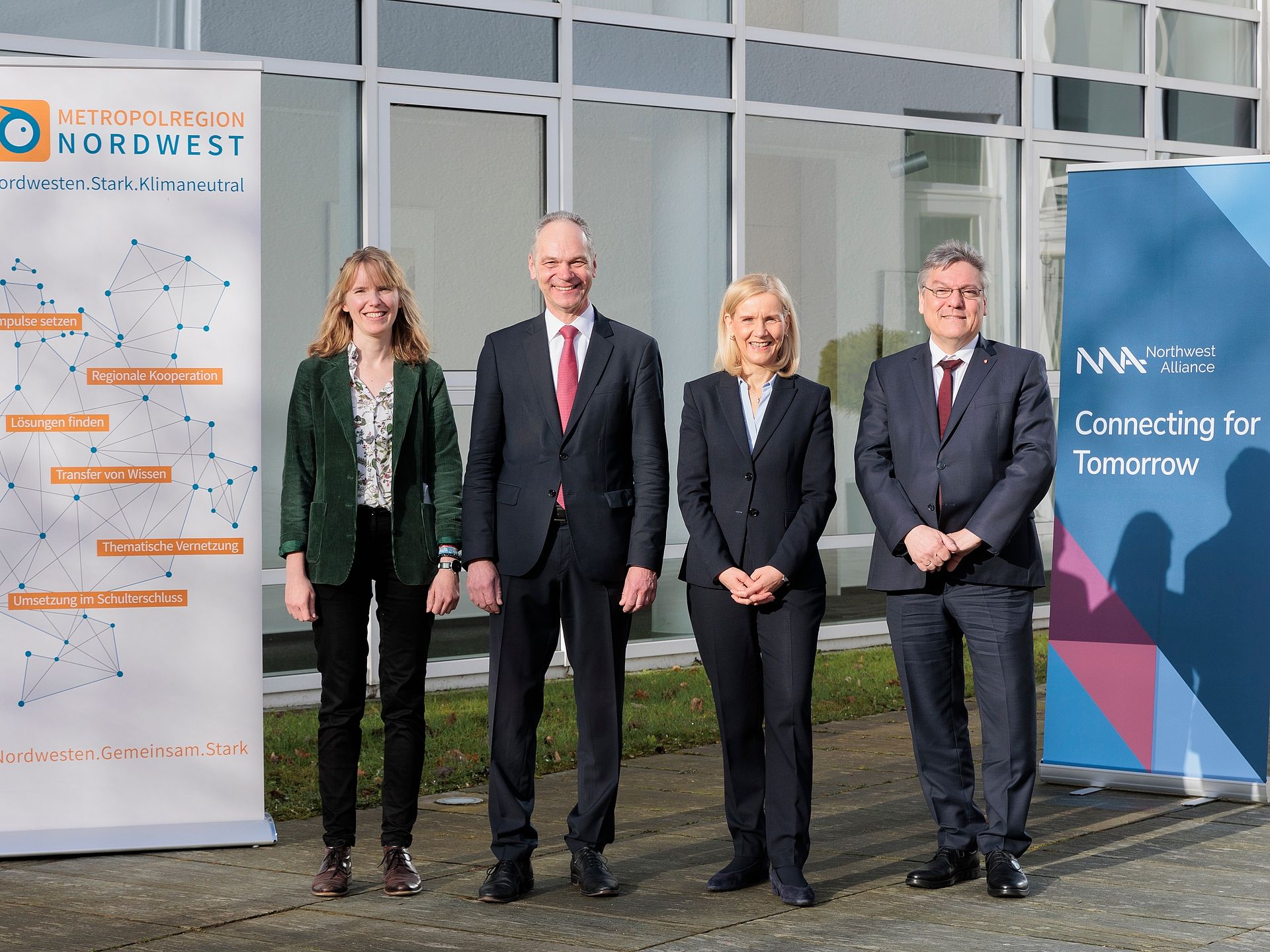

There, Professor Jutta Günther, President of the University of Bremen, and Professor Ralph Bruder, President of the University of Oldenburg, presented their joint proposal as part of the German federal and state governments’ Excellence Strategy. Under the title “Northwest Alliance: Connecting for Tomorrow,” the two universities are applying for the title of University Excellence Consortium and aim to further develop northwestern Germany into a vibrant scientific region where cutting-edge research and social responsibility go hand in hand.
The HWK – Institute for Advanced Study, which supports excellent research and internationalization in the northwest through its research funding, provided the ideal setting for the event. The HWK is a cooperating partner of the universities within the framework of the Excellence Initiative. Following a welcome by Dr. Steffen Bandlow-Raffalski (Head of Program Society, HWK) and the presentation of the Excellence Alliance proposal, the alliance’s strategy and vision, as well as opportunities for political support to strengthen the Northwest as a hub of academic excellence, were discussed with the guests. In attendance were representatives of the Bremen State Parliament, the Lower Saxony State Parliament, and the German Bundestag, as well as representatives of the Lower Saxony Ministry of Science and Culture and guests from Groningen. Close cooperation between the two North German universities and the University of Groningen has existed for many years – at the same time, Groningen is also a Northwest Alliance international partner. In addition to substantive issues, the event also provided ample opportunity for exchange between the fields of science and politics and underscored the importance of the proposal for the region’s scientific profile.
“A successful University Excellence Consortium proposal secures a long-term perspective for our cutting-edge research thanks to the seven-year funding cycle. We combine academic excellence with social responsibility for a sustainable Northwest,” emphasized Professor Ralph Bruder, President of the University of Oldenburg.
“Cross-state collaborations are always very complex – just consider the different legal frameworks in both federal states. But our intensive cooperation shows how beneficial it is to join forces to effectively pool academic resources in the Northwest and fully exploit the region’s potential,” stressed Professor Jutta Günther, President of the University of Bremen.
“We are very pleased that, as the Metropolitan Region Northwest Germany, we can support the University of Bremen and the University of Oldenburg in this important endeavor. An academic spirit of innovation is a driving force in our region. Through the Northwest Alliance’s strong network with its diverse partners, this innovative strength is carried into the regional economy, thereby offering direct added value for the people here in the Northwest,” says Eduard Dubbers-Albrecht, chairperson of the Metropolitan Region Northwest Germany, who will also be on site during the German Science and Humanities Council campus visit as part of the Excellence Strategy in April 2026.
Background
The “Connecting for Tomorrow” University Excellence Consortium proposal was submitted as part of the German federal and state governments’ Excellence Strategy. Individual universities or a consortium of two to three universities that already have what are known as Clusters of Excellence can apply for the title of University of Excellence individually or University Excellence Consortium together. The clusters are projects funded by the federal government in which the respective universities conduct internationally competitive cutting-edge research. Bremen and Oldenburg have four such clusters in the fields of hearing research (Hearing4all.connect), animal navigation (NaviSense), marine ecosystems (The Ocean Floor), and sustainable space research (The Martian Mindset).
There are currently ten German Universities of Excellence nationwide. This number is to be increased from the current pool of applicants to a maximum of 15 universities. The German Science and Humanities Council will conduct site visits and evaluate the universities in April 2026. Following successful evaluation, the selected universities will receive annual funding of between 10 and 15 million euros for individual universities and between 15 and 28 million euros for university consortia, depending on the proposal. The decision on funding will be made in October 2026.
About the Northwest Alliance
The Northwest Alliance brings together two reform-oriented universities with decades of experience in research, teaching, and knowledge transfer. Together, with approximately 580 professorships, 6,400 staff members, 2,700 doctoral candidates, and 34,000 students, they form the heart of a high-performing research hub in the Northwest. The alliance’s goal is to combine excellent research with social responsibility and to find innovative solutions to regional and global challenges. In the medium to long term, the region is to be further developed into a cohesive hub for research and knowledge transfer. A central role in this is played by the numerous academic and non-academic institutions in the Northwest, with which both universities are already affiliated, as well as the HWK – Institute for Advanced Study, which has served as a link between the universities for more than 25 years. The alliance also sees itself as part of the international community, in close partnership particularly with the University of Groningen (Netherlands), with which both universities have been cooperating for decades. The Northwest Alliance thus not only connects the federal states of Bremen and Lower Saxony, but also represents a strong international network in a European border region.
https://northwest-alliance.de/en/
About the Metropolitan Region Northwest Germany
The Metropolitan Region Northwest Germany is one of eleven German European metropolitan regions. Business, administration, politics, and academia work closely together to jointly develop the region and its future-oriented sectors and to position it strongly within the international competitive landscape. Members of the Bremen-Oldenburg Metropolitan Region in the Northwest Association include the districts of Ammerland, Cloppenburg, Cuxhaven, Diepholz, Friesland, Oldenburg, Osnabrück, Osterholz, Vechta, Verden, and Wesermarsch; the independent cities of Delmenhorst, Oldenburg, and Wilhelmshaven, as well as the municipalities of Bremen and Bremerhaven, the Bremen Chamber of Commerce and Industry (IHK) for Bremen and Bremerhaven, the Oldenburg Chamber of Commerce and Industry (IHK), the Elbe-Weser Chamber of Commerce and Industry (IHK), and the two federal states of Bremen and Lower Saxony.
https://www.metropolregion-nordwest.de/portal/seiten/about-us-900000302-10018.html