

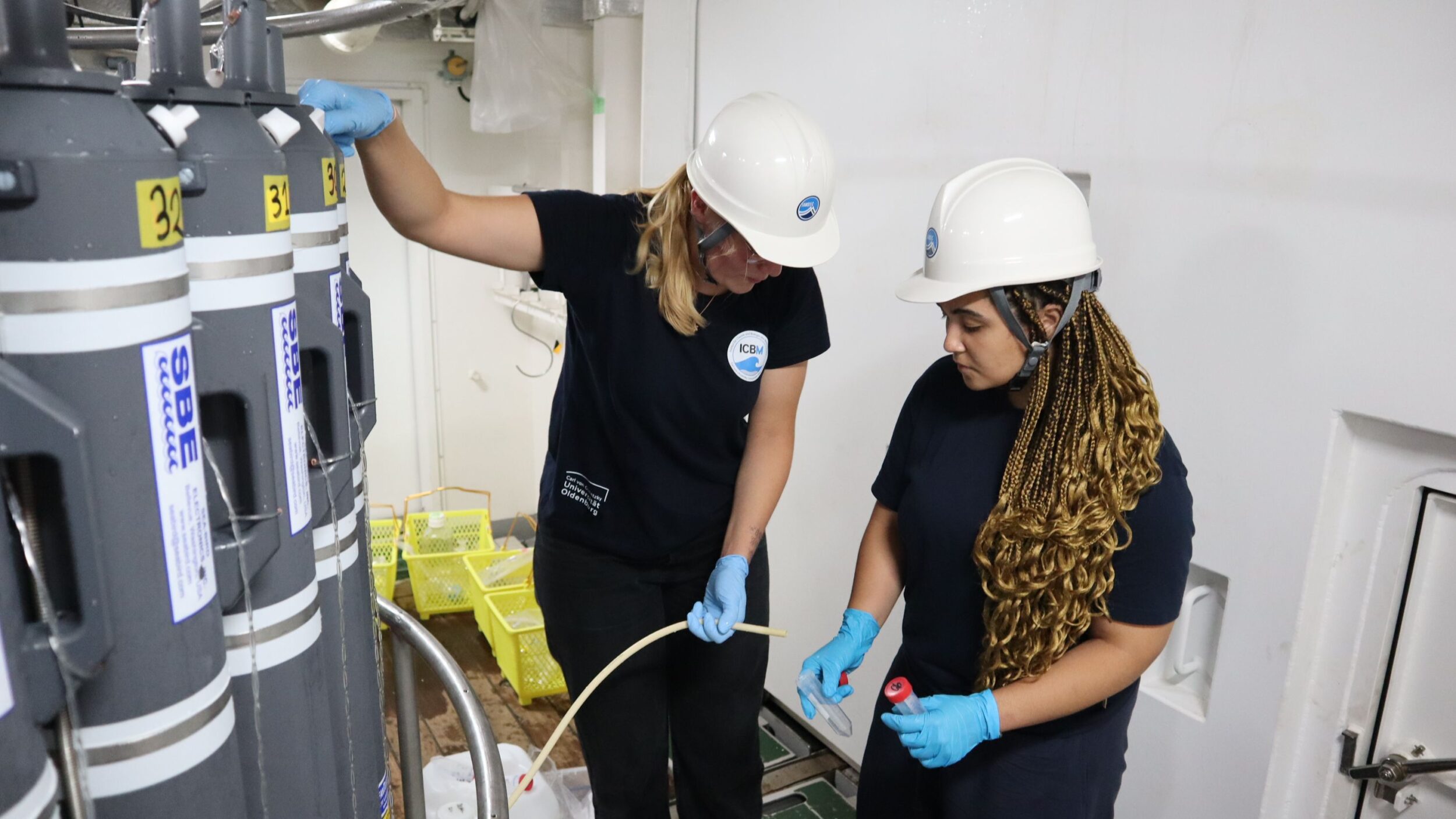

Two doctoral candidates from the Ocean Floor Cluster of Excellence joined a scientific expedition in the western Pacific this summer. On board the Kaimei, a Japanese research vessel, they analysed the mysterious components of seawater – and also got to experience Japanese bathing culture.
Fenna Alfke and Julia Pamphile dos Santos had an exciting time this summer: the two doctoral candidates from the University of Oldenburg’s Institute for Chemistry and Biology of the Marine Environment and the Marum Center for Marine Environmental Sciences at the University of Bremen spent several weeks in August and September at sea in the northwestern Pacific. There was plenty of work for them to do on board RV Kaimei. “Our days were very varied,” Julia observes. Between working on deck, analysing water samples and drill cores in the lab, attending meetings and performing initial data analyses, the two barely had time to catch their breath. “Sometimes we basically had to be in several places at once to collect samples from different instruments,” explains the marine scientist from the University of Bremen.
Julia and Fenna are two of the fifteen PhD candidates in the Ocean Floor Cluster of Excellence, a major marine research initiative that brings together the expertise of the Universities of Bremen and Oldenburg. Julia is a member of Prof. Dr Kai-Uwe Hinrichs’s Organic Geochemistry research group at the University of Bremen, while Fenna is doing her doctorate with Prof. Dr Thorsten Dittmar, who heads the Marine Geochemistry research group at the University of Oldenburg. Both began their doctoral projects at the start of the year and are now well into the data collection phase. On board the RV Kaimei, one of Japan’s most modern research vessels, the researchers collected water samples off the Japanese coast, where the ocean is up to 5,500 metres deep.
The doctoral candidates are investigating a mysterious and often overlooked component of seawater – organic matter, or put simply: the detritus of marine life. Julia is studying tiny particles of this matter, no more than a few thousandths of a millimetre in size. These particles are often clumped together in a mixture of components such as the husks of dead algae, living or dead bacteria and the faeces of larger organisms. Known as “marine snow”, these particles sink slowly from the upper layers of the ocean to the deep-sea floor. Fenna is focusing on even more finely dispersed substances known as dissolved organic matter, or DOM, which consists of polysaccharides, proteins and millions of other complex biomolecules that are excreted by living organisms and then float around individually in the water as dissolved matter.
“I have always been fascinated by all the things you can find in a single drop of water,” says Julia. “This perspective helps us to realise just how important every process, no matter how insignificant it may seem, actually is in maintaining the world in balance.”
The carbon bound in organic matter often remains in the ocean for thousands of years
The organic matter in the sea plays a significant role in the climate system: “It is a key component of what is known as the biological carbon pump,” explains Fenna. This is the term experts use to describe the mechanism by which atmospheric carbon is transported from the ocean’s surface into the deep ocean interior. As an example, algae in the uppermost layers of water absorb carbon dioxide from the atmosphere and convert it into organic molecules. The life and death of the algae themselves, but also the activity of microbes and living organisms, produce both dissolved matter and organic particles which sink or are carried by currents into the deep sea. The carbon bound within this material often remains in the ocean for thousands of years. “Dissolved organic matter in the deep sea is one of the Earth’s largest carbon reservoirs and thus plays an enormously important role in the climate,” explains Fenna.
Fenna and Julia are mainly interested in the decomposition of this matter, because this process determines how long the carbon remains stored in the sea. “Why aren’t the dissolved molecules broken down by microorganisms, given that there are so many specialised life forms in the deep sea?” Fenna wonders. She combines different analytical methods to find out how degradation processes in the water differ from those in the seabed, for example. Julia examines which processes play a role within the particles.
Although the two researchers are pursuing their doctorates at different universities, they work closely together – thanks to the Ocean Floor Cluster of Excellence. “Fifteen doctoral candidates started their theses almost simultaneously within the cluster. This means that we have a large network through which we can support one another and exchange ideas,” explains Fenna. Julia, Thorsten Dittmar and technician Lukas Dirksen from the Marum centre quickly became a team on board the Kaimei. “We had a really good dynamic,” says Julia, “We all worked together as one, and we all put in a lot of effort to ensure that everyone succeeded.”
The Cluster of Excellence is a unique environment. I can collaborate with researchers from all over the world.
Julia Pamphile dos Santos, PhD candidate at Marum
In other respects, too, the two PhD candidates were impressed with their doctoral programme. “The Cluster of Excellence is a unique environment. I can collaborate with researchers from all over the world and broaden my horizons,” explains Julia. In addition to the excellent academic supervision, Fenna says she also values the opportunity to work in a highly interdisciplinary manner: “Thanks to the collaboration between a wide variety of research institutions, we doctoral candidates have access to a superb infrastructure.”
The Oldenburg PhD candidate was able to make the most of these unique opportunities immediately after the expedition. Together with Thorsten Dittmar, she analysed the samples collected on the Kaimei in a lab run by the Japan Agency for Marine-Earth Science and Technology (JAMSTEC) near Tokyo.
Fenna and Julia coped well with their busy days at sea, thanks, among other things, to Japanese bathing culture. “The ship was equipped with ofuro – traditional Japanese bathtubs designed specifically for relaxing in very warm water,” explains Fenna. “So even on days when we were completely exhausted by the evening, we were well looked after.”