
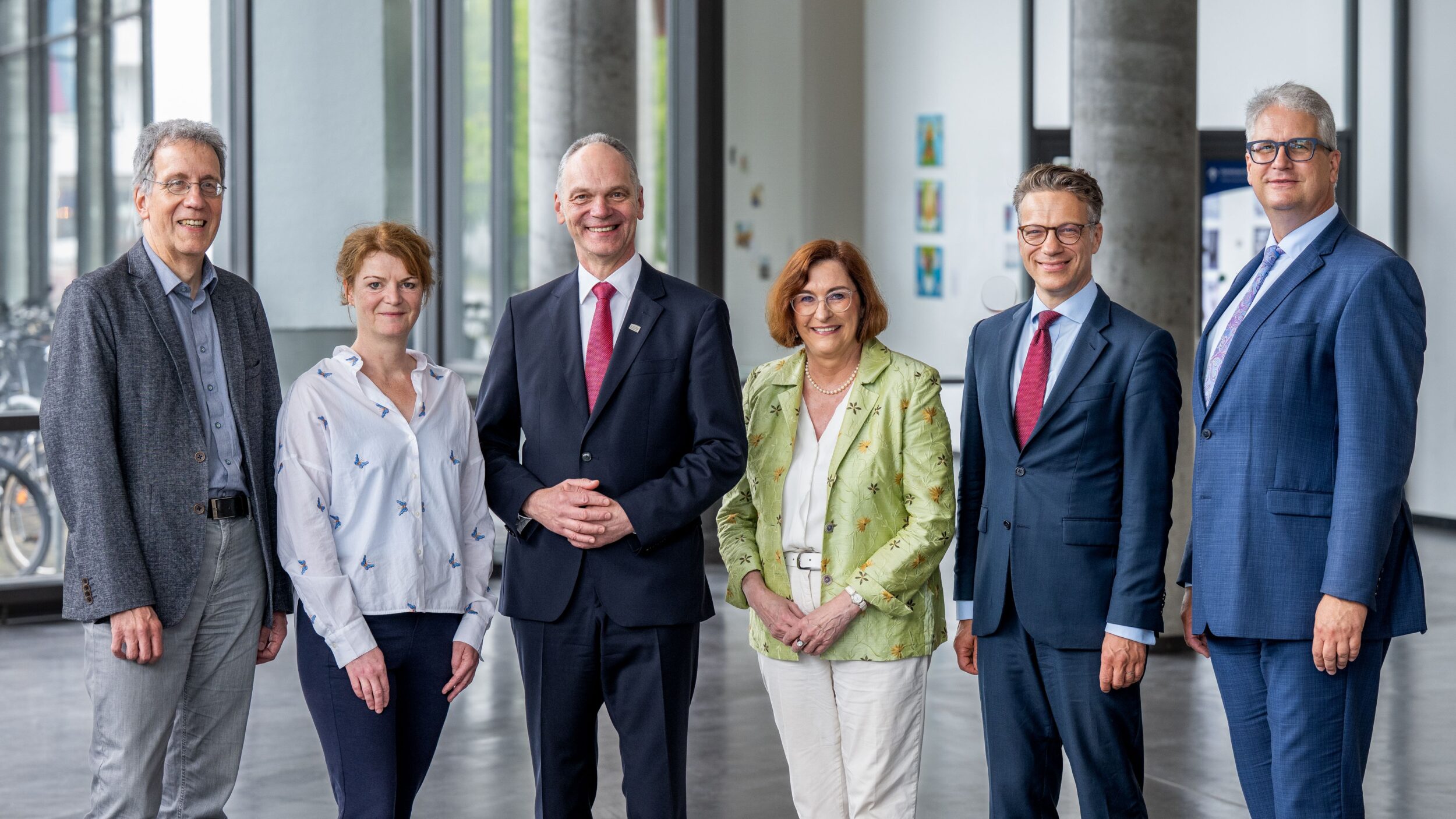

The University’s Presidential Board will soon have six members instead of five. The Senate decided today that Vice Presidents Katharina Al-Shamery and Ralf Grüttemeier are to be succeeded by Gun-Britt Kohler, Michael Wark and Matthias Wendland.
Just a few weeks after the early re-election of Prof. Dr Ralph Bruder as University President, the Presidential Board is bound to undergo a reshuffle and will have six members instead of five from September.
Following the proposals put forward by President Bruder, the University Senate today confirmed chemist Prof. Dr Michael Wark as new Vice President for Research and Transfer, and literary scholar Prof. Dr Gun-Britt Kohler as Vice President for Academic Career Paths, Equal Opportunities and International Affairs. In addition, the Senate voted to appoint legal scholar Prof. Dr Matthias Wendland to the new Presidential Board portfolio of Vice President for Digitalisation.
Theologian Prof. Dr Andrea Strübind was elected for a second term as Vice President for Studying and Teaching. Together with University President Prof. Dr Ralph Bruder and the full-time Vice President for Administration and Finance, Jörg Stahlmann, they will constitute the university’s executive leadership as of 1 September.
The Senate’s vote on the new members of the Presidential Board, together with the opinion of the University Council, will now be submitted to the Lower Saxony Ministry of Science and Culture (MWK) for approval. The three Vice Presidents will be appointed for three-year terms, whereas the regular terms of office previously consisted of two years.
President Bruder: Facing important challenges for the future
University President Ralph Bruder said he was looking forward to working with the new Presidential Board. “The university has achieved a lot in recent years and is facing important challenges for the future. Together, we will work to maintain this successful course and provide fresh impetus,” Bruder emphasised.
He added that the university carries out cutting-edge research – as evidenced, among other things, by its three Clusters of Excellence – and is consistently moving forward with the expansion of its University Medicine and its close strategic collaboration with the University of Bremen within the Northwest Alliance. These examples were indicative of a highly dynamic development process which the Presidential Board aims to continue. “To this end, we have recruited three experienced and distinguished individuals who will greatly strengthen the university’s leadership,” said Bruder.
He expressly thanked outgoing Vice Presidents Prof. Dr Katharina Al-Shamery and Prof. Dr Ralf Grüttemeier for their “exceptional commitment to the university in unusual times”. This was an allusion to the Northwest Alliance’s application as a new University Consortium of Excellence within the federal and state governments’ Excellence Strategy programme.
Wark: Bringing research findings directly to people
Professor Wark, future Vice President for Research and Transfer, announced plans to further work together with the University of Bremen in advancing the research in jointly identified key areas and increase its visibility. “We need to identify and develop new topics for future coordinated research programmes – in Oldenburg, at both universities, or also with our partner university in Groningen”, he said. “In many areas we can already build on our long-standing cooperation – and in the longer term intensify our collaboration with non-university research institutions in the region as well.”
On the subject of knowledge transfer from the university to the business world and society, Wark said he would prioritise an even closer interaction with schools, local authorities and businesses: “My objective is to increase public awareness of the university’s outstanding research results and adopt a more direct approach, for example by establishing new discussion formats at various locations across the city and the region.”
Strübind: Artificial Intelligence marks a “revolution” in teaching and learning
Professor Strübind, the re-elected Vice President for Studies and Teaching, talked, among other things, about the role of artificial intelligence. “AI marks a revolution in teaching and learning processes. It is changing the way knowledge is generated, applied, financed and disseminated,” she said. This is rapidly transforming the relationship between learners, learning processes and learning outcomes, as she explained, adding that she intends to lead an in-depth discussion about this at all the university’s levels. She also envisages a reform of the examination system, with a view to enhancing efficiency in the management of studies at the University of Oldenburg.
Strübind underlined the importance of further integrating teacher training at the two Northwest Alliance universities; among other measures, she plans to make it easier for student teachers to complete the cooperative study programme offered by the two universities, which has been available for years and enables them to take a combination of subjects in both Oldenburg and Bremen, and also to expand the range of subject options. Another goal for Strübind is to ensure the continuation of the Certificate in Education Critical of Anti-Semitism in Lower Saxony in the Context of Schools (ZABIN), which is offered statewide by the University of Oldenburg.
Kohler: Raising the international profile of the university and the Northwest Alliance
As future Vice President for Academic Career Paths, Equal Opportunities and International Affairs, Professor Kohler said she wants to bring the ‘intersecting topics’ within her portfolio even closer together where possible, and merge them in the university’s structures. A key focus of her vice-presidency will be to intensify international networking and raise the profile of the University of Oldenburg, the Northwest Alliance and the entire north-west region as a research hub, she said. In doing this, Kohler aims at taking into account the challenges posed by the global situation on the one hand, and the diverse needs of the faculties, disciplines and individuals on the other. She also emphasised the importance of continuing the process of internationalisation in teacher education.
In addition to supporting early-career researchers, she aims to focus on improving the situation of research staff and employees in technical and administrative roles: “People at our university should be able to thrive and fulfil their full potential, feel valued and find it easier to balance their work with family responsibilities,” Kohler explained. She also plans to intensify the coordination of the university’s wide-ranging anti-discrimination activities.
AI at the centre of a comprehensive digitalisation strategy
Addressing the Senate, Matthias Wendland, future Vice President for Digitalisation, emphasised the university’s special social responsibility which obliged it to play an active role in shaping the digital transformation. In a world of AI and data-driven science, the aim must be to responsibly combine institutional capacity for action, academic excellence and digital sovereignty, he explained.
Artificial intelligence is at the centre of a comprehensive digitalisation strategy, he said. “Building up institutional AI capability in all the university’s core functions is a joint endeavour,” said Wendland. He listed four strategic focus areas: AI expertise in research, teaching and administration, high-performance AI and data infrastructures, AI-supported learning and assessment environments, and a modern process architecture. Wendland emphasised that by drawing on its broad range of disciplines, its reform tradition and its digital expertise, the University of Oldenburg has the potential to develop a future-proof profile as a university that translates AI into effective and responsible research, teaching and administrative processes.
About the Board members
Prof. Dr Michael Wark
Prof. Dr Michael Wark is a lecturer in technical chemistry, head of the “Photocatalysis and Sustainable Raw Material Utilisation” research group and, since 2019, Dean of the School of Mathematics and Science. The chemist received his undergraduate and doctoral degrees from the University of Bremen. Research stays took him to the École Nationale Supérieur de Chimie in France and the University of Notre Dame in the US. In 2002, he took up a research post at the Leibniz University Hannover’s Institute of Physical Chemistry and Electrochemistry, where he habilitated in 2004 and continued to teach and conduct research until 2010, also as an adjunct professor. He served on the Leibniz University’s Senate for four years and then became a professor at Ruhr University Bochum, before moving to the University of Oldenburg in 2013. His research focuses on materials and chemical processes for renewable energies and resource conservation. Wark is a member of the university’s Center for Transformations and Sustainable Futures, TRUST@UOL, and takes part in its central committee.
Prof. Dr Andrea Strübind
Prof. Dr Andrea Strübind lectures in church history and historical theology. She studied Protestant theology, history and Jewish Studies in Berlin and Jerusalem, and received her doctoral degree from the Kirchliche Hochschule Berlin in 1990. She earned her habilitation at the University of Heidelberg in 1999, then taught and conducted research in Heidelberg and Lüneburg before accepting a professorship at the University of Oldenburg in 2006. Strübind was Dean of the School of Humanities and Social Sciences from 2013 to 2017, then served as Director of the Institute of Protestant Theology and Religious Education and, from 2018, as an internal member of the University Council, before being elected as Vice President for Studies and Teaching in 2023. She is also Chair of the Intercultural Jewish Studies programme. Her research interests include contemporary church history, religious non-conformism and the Christian roots of the civil rights movement led by Martin Luther King.
Prof. Dr Gun-Britt Kohler
Prof. Dr Gun-Britt Kohler lectures in Slavic Literary Studies. She studied Slavic Studies, Romance Studies and Russian Literary Studies in Würzburg and Paris. After taking her doctoral degree in Würzburg she moved to the University of Oldenburg in 2001 as a research associate. From 2007 to 2013, she conducted research and taught as a junior professor there before obtaining a full professorship. She has served as Director of the Institute of Slavic Studies several times since 2015 and was Dean of the School of Linguistics and Cultural Studies from 2021 to 2023, after already having served as Dean of Studies for the School from 2011 to 2015. In 2023 she took over as Acting Director of the Institute of Material Culture for two years. She has also been a member of the University Senate since 2023. Kohler is Vice Chair of the Association of German Slavic Studies and her research focuses in particular on ‘smaller’ Slavic literatures and literary systems.
Prof. Dr Matthias Wendland
Prof. Dr Matthias Wendland, LL.M. (Harvard), is Professor of Civil Law and the Law of Digital Transformation and heads the master’s degree programme in Information Law. He is one of the University’s Ombudspersons and a member of the Scientific Centre for Methods of Artificial Intelligence and Data Science, WiZArD. He studied law in Berlin and Leuven as well as at Harvard Law School and the Fletcher School of Law and Diplomacy. After passing his state examinations and graduating from Harvard, he completed his doctoral degree and habilitation at the Ludwig Maximilian University of Munich. Before coming to Oldenburg, he taught and conducted research in Heidelberg, Freiburg and Graz. Wendland has won several awards and conducts interdisciplinary research within international networks, focusing on key legal issues in the fields of AI, agent-based systems and quantum technologies. He is head of the Digital Transformation Lab, the University’s AI Governance testbed dedicated to the development of operational AI systems and trustworthy AI.
Editor: Deike Stolz, redaktion@uol.de