

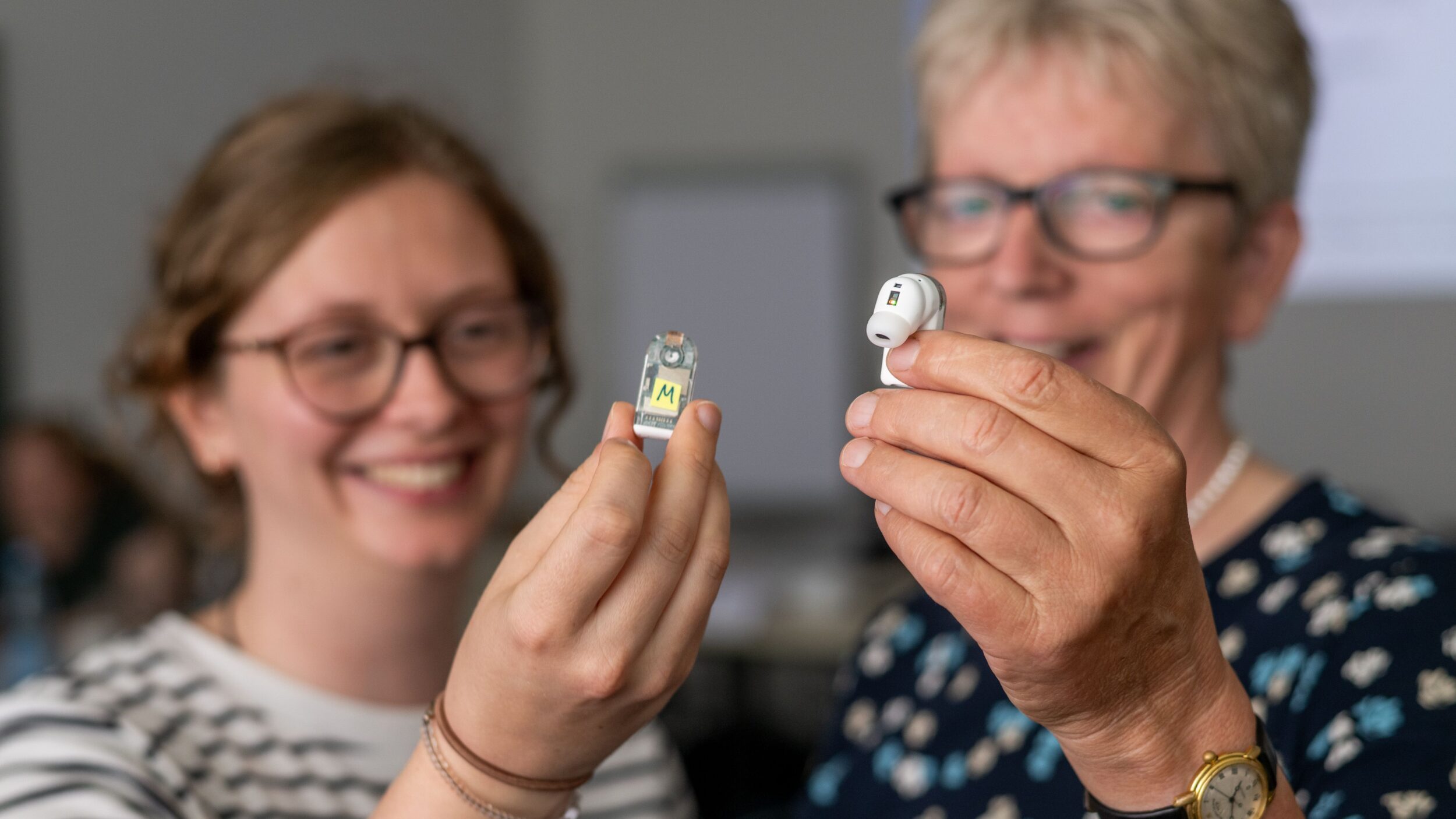

Research advisory boards bring citizens closer to science – and researchers closer to the lived reality of study participants. A visit with the advisory board of the Bremen-Oldenburg research training group HEARAZ, which aims to transform “hearables” into in-ear health monitors.
Hans-Jürgen Hagenah carefully studies the picture Mira Richts has handed him. After completing a master’s degree in hearing technology and audiology in Oldenburg, she is now pursuing a doctorate in the Faculty of Computer Science at the University of Bremen and aims to develop hearing aids into analytical tools. The drawing, which will later spark lively discussions, plays a role in this effort. For now, the 74-year-old first describes what he sees in the picture. An aproned woman is standing at a kitchen sink washing a plate. Since the faucet is still running despite the sink being full, water is gushing onto the floor. In the background, a boy has climbed onto a stool to reach the cookie jar stored in the cupboard, stumbling in the process. “What is the girl next to him doing?” Richts asks. “She is reaching out her hand, hoping to grab a cookie,” Hagenah explains.
The small microphone that Hagenah is wearing reveals that this conversation is about more than just small talk. Hagenah is from Petersfehn, and is a member of the research advisory board for Hearable-Centered Assistance, a joint research training group between the University of Oldenburg and the University of Bremen. “Hearables” are devices worn in the ear, such as headphones or hearing aids. In HEARAZ, the abbreviated name of the project, Richts and nine other doctoral researchers are investigating the potential for hearing aids to do more than provide hearing capability and become small in-ear health monitors.
Mira Richts plans to collect speech samples from participants soon at the Reha-Zentrum (rehabilitation center) and the University Clinic for Geriatric Medicine, both in Oldenburg. Today, she is trying out her experimental setup with Hans-Jürgen Hagenah and other advisory board members. “Cognitive changes affect our speech,” she explains. This is why she intends to develop a computer algorithm at the Cognitive Systems Lab at the University of Bremen that uses speech to detect whether someone is suffering from dementia or a temporary state of confusion known as delirium.
Using this algorithm, hearables could function as an early warning system for cognitive abnormalities in everyday situations. For example, hearing aids and modern headphones could use their built-in microphones to detect changes in the wearers’ speech. The research training group aims to develop health-related applications for such “hearables.”
Mira Richts, who studied at the University of Oldenburg before beginning her work in Bremen, plans to collect “spontaneous speech” for her research. To do this, she needs unscripted narrations and conversations that are as natural as possible. The picture with the kitchen scene serves as a starting point. Targeted questions and deliberate shifts in topic are intended to keep the conversation flowing as naturally as possible.
“If I feel like I’m being interrogated, I’ll respond accordingly. But the interaction with my conversation partner felt like we’d met by chance, and she seemed genuinely interested in me,” says Renate Lass. She believes that rapport between researchers collecting data and their participants is invaluable. Renate, who is 84 years old, travels from Bad Zwischenahn to attend the board meetings. One of the reasons she signed up when she read about the research advisory board in the newspaper is that she has been personally affected by hearing loss.
Over the past year, about ten people without a research background have been supporting the doctoral researchers and professors in the research training group. Charlotte Janning, Genise Buurman, Julia Terveen, and Buğse Yüceer organize the research advisory board. Many advisory board members live in Oldenburg and the surrounding region. Berbel Häseker travels 45 minutes from Bremerhaven to attend the meetings. Having experienced a stroke herself, she is part of several self-help groups for stroke patients in northwestern Germany. “Because of this, I am in contact with many people and want to bring their perspectives into this work,” she says.
Incorporating the personal experiences of those affected is exactly what research and patient advisory boards are all about. “Especially in foundational research, researchers are rarely, if ever, in contact with patients. Advisory boards help them gain insights into the lives of those who might later benefit from their work,” explains PD Dr. Anna Levke Brütt. She conducts research at the University of Oldenburg and University of Hamburg on how citizens can be involved in health-related research and how their influence on the research can be measured and evaluated.
A good example of differences in perspective between outsiders and researchers is the drawing that Mira Richts plans to use as a conversation starter for her study. It was not chosen at random. Developed more than 50 years ago in the USA, the Cookie Jar Theft image was originally used for speech diagnostic procedures and has since been used in many additional studies.
While several members of Oldenburg’s research advisory board were able to spontaneously recall personal stories based on the picture, others found it difficult to relate to. “A mother with an apron in the kitchen – that’s not my world; it’s more like a scene from a movie,” Berbel Häseker notes. Because of this, the picture didn’t prompt many personal memories. Another board member was unable to decipher the word “cookie jar” – a potential problem for the visually impaired and non-English speakers.
“It’s true – the drawing is stereotypical of a specific cultural context and era,” says Mira Richts. At the same time, it is well-established and has proven itself time and again. “I find the ideas fascinating. Maybe I can use different conversation starters in the future.”
Finding a balance between the real-life input from citizens and the often strict academic standards is one of the challenges of participatory research. “Doctoral researchers can’t implement every suggestion in their research projects, but they should at least engage with the ideas,” says Anna Levke Brütt. “Our central question is how to develop approaches that make the research more human-centered.” Each adjustment that accomplishes this improves the research itself because it leads to results that are more in tune with real life and can benefit those for whom they are intended more quickly.