

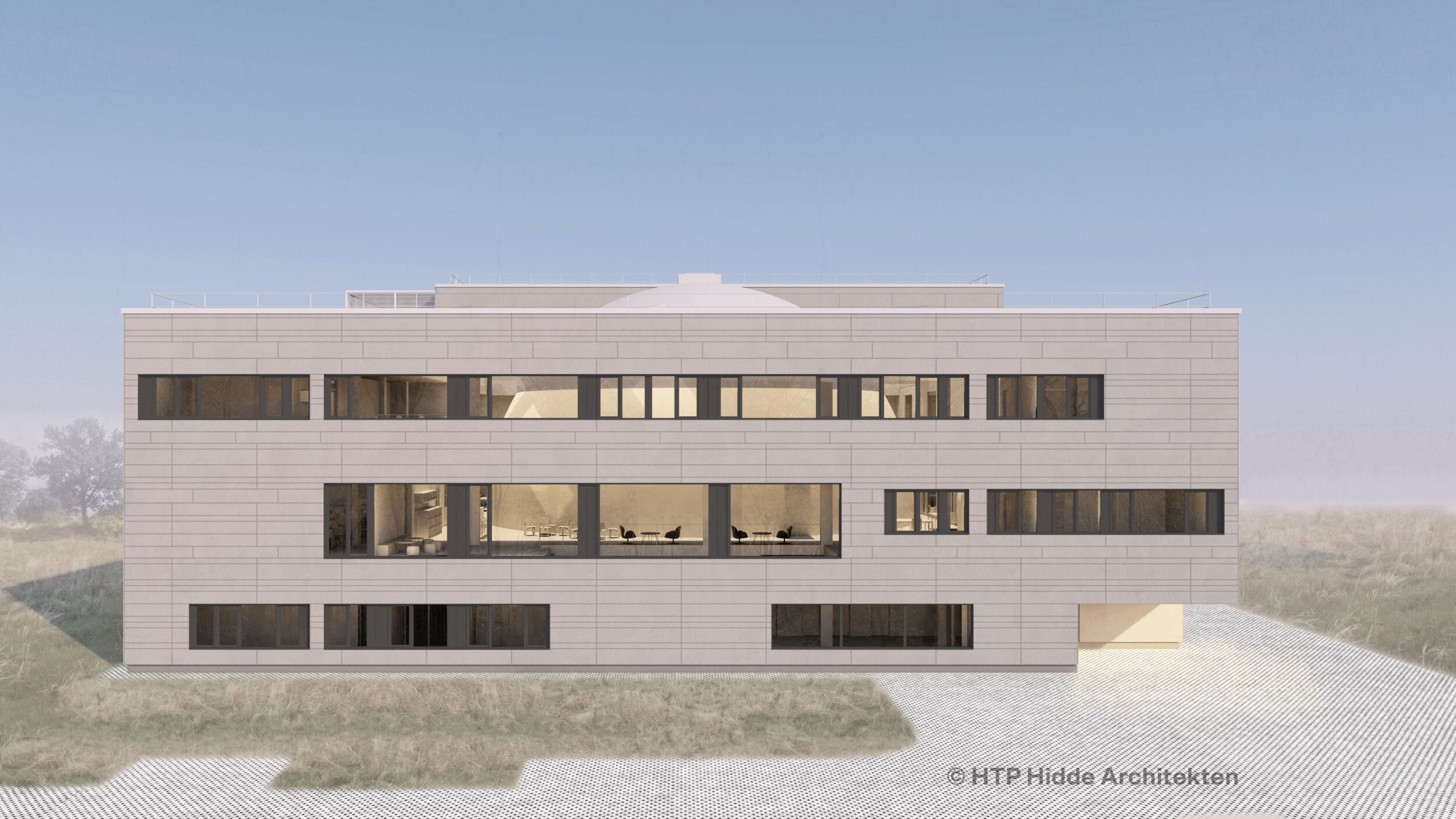

The university is set to acquire a unique research facility, as recommended by the German Council of Science and Humanities. The ‘NaviGate’ building has been designed for the study of animal navigation in realistic conditions.
In its latest recommendation on funding for research facilities at universities, the German Council of Science and Humanities (WR) has endorsed the construction of the new “NaviGate” research facility at the University of Oldenburg. The proposal was spearheaded by Oldenburg-based biologist and animal navigation expert Prof. Dr Henrik Mouritsen, spokesperson for the “NaviSense” cluster of excellence and the Collaborative Research Centre (SFB) “Magnetoreception and Navigation in Vertebrates”. The German Council of Science and Humanities rated the proposal as “outstanding”.
“With the NaviGate research building, we are taking the University of Oldenburg’s excellent research in the field of animal navigation to a new level. The planned building offers conditions unique worldwide for addressing current and future questions in animal navigation research, sensory biology and neurosensorics,” explained University President Prof. Dr Ralph Bruder. The work in the research building will also yield important insights for nature conservation. This includes, for example, anthropogenic and environmental stress factors that influence the navigation and ecology of migratory animals.
One of the most impressive behavioural feats of animals such as migratory birds and insects is their ability to navigate to their destination with the utmost precision over enormous distances. Many aspects of these astonishing migrations are still poorly understood. “In recent years, we have been able to show that animals use different sensory cues simultaneously to navigate precisely. How these cues are combined has remained unclear to date due to a lack of suitable research infrastructure. ‘NaviGate’ will, for the first time, offer researchers worldwide the opportunity to present navigating animals with a precisely controllable virtual reality across all six sensory dimensions,” emphasises Mouritsen.
Navigation studied under conditions that closely resemble the natural environment
The maximum funding amount recognised by the German Council of Science and Humanities for research buildings and large-scale equipment is around 99 million euros. The centrepiece of the new building, with around 2,800 square metres of floor space, is a dome with a diameter of 18 metres, in which the navigational behaviour of, for example, insects, birds, fish and microorganisms can be studied under conditions that closely resemble the natural environment. Inside this “Non-Magnetic Multisensory Virtual Reality Dome” (NMVR Dome), it will be possible to generate various magnetic fields or simulate disturbances such as electromagnetic pollution and light pollution. The room will be equipped with laser-based projectors, such as those used in planetariums. These devices can project not only the starry sky but also specific visual stimuli or realistic scenes onto the dome. The entire dome and other parts of the building are made of non-magnetic materials and are shielded from electromagnetic pollution. “This allows researchers to precisely control the magnetic stimuli. Using additional equipment, it is also possible to investigate how sounds or smells affect navigational behaviour,” explained Dr Vivian Meyer, scientific project coordinator for NaviGate.
The modern building concept allows different research groups to share the laboratories. NaviGate aims to bring together leading international experts from the disciplines of biology, physics, chemistry, Computing Science and the social sciences – some of whom are already collaborating within the “NaviSense” cluster of excellence, the Oldenburg Collaborative Research Centre “Magnetic Reception and Navigation in Vertebrates” and the Research Centre Neurosensory Science – to work even more closely as a team.
The building will secure a globally leading role for the University of Oldenburg in animal navigation research for decades to come.
Henrik Mouritsen, Professor of Neurosensory Sciences
Furthermore, NaviGate is intended to serve as a talent hub. The research building offers space for up to four early-career research groups. “Our shared goal will be to gain a profound, interdisciplinary understanding of the senses and mechanisms of animal navigation,” emphasised Mouritsen. This new knowledge could help to improve nature conservation and inspire new technologies. It should also benefit society, ecology and biodiversity as much as possible. “The building will secure a globally leading role for the University of Oldenburg in animal navigation research for decades to come,” the researcher is certain.
As part of the funding scheme for research buildings at universities, the German Council of Science and Humanities (WR) assesses proposals from the federal states for funding of research buildings on behalf of the federal and state governments. Each year, the WR recommends to the Joint Science Conference (GWK) the projects that are to be implemented and co-funded by the federal government up to 50 per cent. The decision on inclusion in the funding scheme lies with the GWK.