

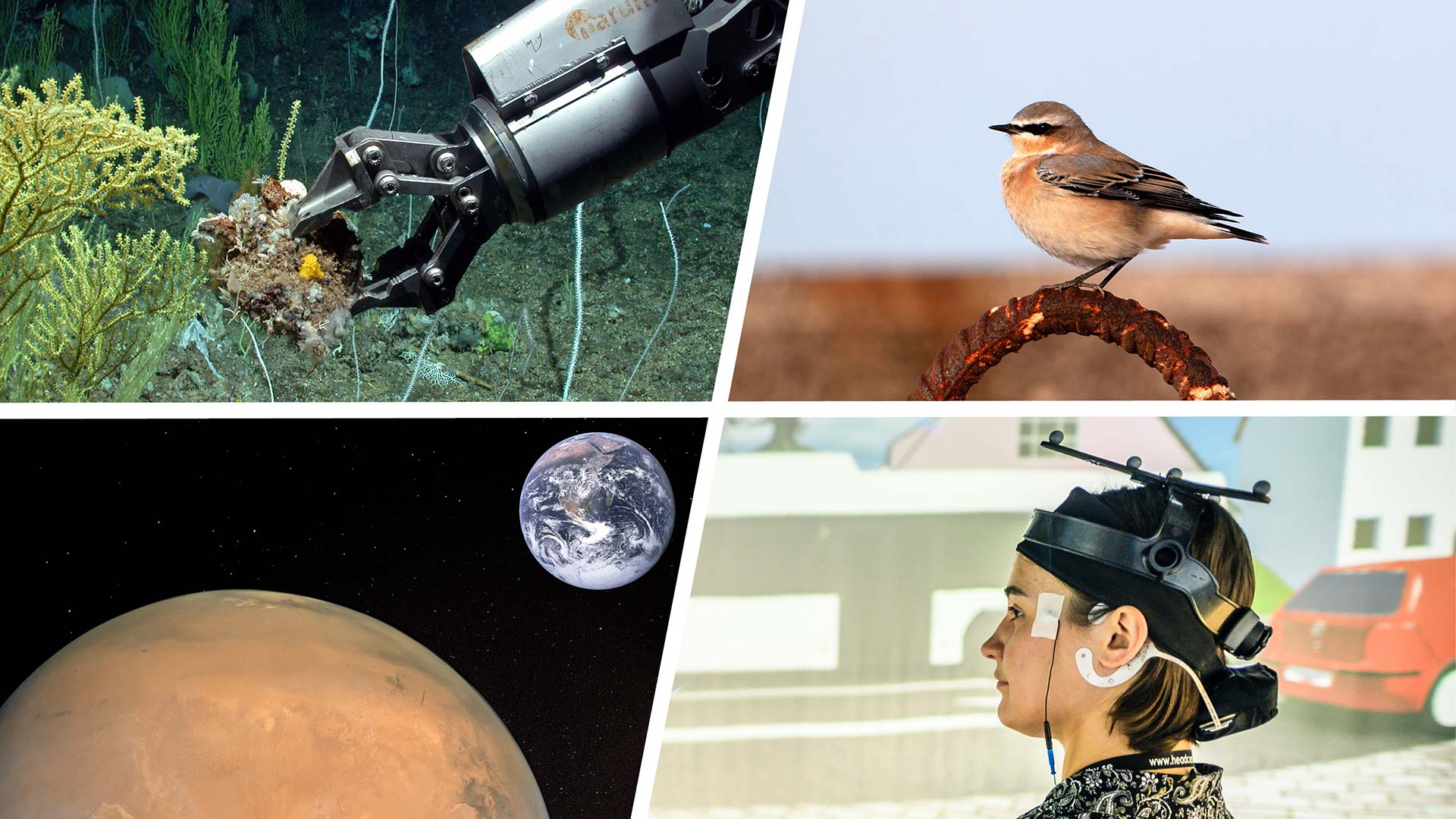

From the ocean floor to Mars, from human hearing to animal navigation abilities – researchers in the four Clusters of Excellence at the universities of Oldenburg and Bremen are focusing on a wide variety of topics. The teams began their work at the beginning of the year. We present a brief overview of the Clusters here.
The Ocean Floor – Earth’s Uncharted Interface
Oldenburg researchers have been involved as a partner in the University of Bremen’s The Ocean Floor – Earth’s Uncharted Interface Cluster of Excellence since 2019. The universities of Oldenburg and Bremen jointly submitted the current application for renewal of funding. In the Cluster, they will pool their expertise with the aim of further advancing our understanding of the role of the ocean floor in biogeochemical cycles and biodiversity under changing climatic conditions. With its research, the Cluster will contribute to a scientific basis for the protection and sustainable use of the oceans.
The ocean floor acts as a dynamic interface and fulfils wide-ranging functions for the entire Earth system. The researchers in the Cluster investigate the processes that control global matter fluxes towards, above, and in the ocean floor. This involves deciphering the processes that regulate the transport of biogenic particles to the ocean floor and their transformation under changing environmental conditions, analyzing the transfer of carbon and other elements between the ocean floor and seawater, and understanding how ecosystems on the ocean floor react to environmental changes. In view of the scientific and technological complexities, these objectives can only be achieved in the context of an interdisciplinary research network.
Hearing4all.connects
The Cluster aims to improve the prediction, diagnosis, and treatment of hearing loss. Hearing4all (H4a) has already achieved significant results over the course of two previous funding periods since 2012. Now, under the new guiding theme Hearing4all.connects, the research alliance encompassing the University of Oldenburg, Hannover Medical School, and Leibniz University Hannover will expand to include additional disciplines, enabling an even more comprehensive investigation of hearing loss. In the coming years, researchers will pursue new genetic approaches to predicting, diagnosing, and treating hearing loss. They will also explore how artificial intelligence can enable hearing aids and cochlear implants to distinguish more effectively between important and irrelevant sound sources. Another key area of research involves the development of shared data standards. These standards will enable the training of AI-based systems that can predict an individual’s probability of hearing loss.
Researchers also aim to transform hearing aids into comprehensive hearing health systems, using sensor data collected at the ear to provide long-term health data and early indicators for declining health. Hearing4all also seeks to better understand the real-life challenges people with hearing loss face. Researchers will investigate the role of multilingualism in hearing, conduct studies outside the lab in real-world environments, and explore the importance of hearing in social interactions. Close collaboration with non-university partners remains a central component of the Cluster’s work, supporting the rapid transfer of research findings into practical applications.
NaviSense
The mission of the NaviSense team at the University of Oldenburg is to gain a thorough understanding of how animals navigate over long distances. Its findings will be incorporated into nature conservation strategies and technological innovations such as quantum technologies and autonomous navigation systems. The team’s research is divided into four research foci: In the first, the underlying mechanisms of magnetoreception and other senses that animals use to navigate are investigated. The magnetic and celestial compass as well as the processing of sensory information in the brain are also studied in detail. As the magnetic sense of birds seems to be based on a quantum effect, the second research focus is on quantum physical phenomena – in particular phenomena which occur at ambient temperature, like magnetoreception. Most of today’s quantum technologies can only be implemented at extremely low temperatures. Therefore, it would be a major step forward if we can understand how quantum physical processes can be controlled at higher temperatures.
In the third research focus, the team aims to use the findings from navigation biology research in nature conservation. Migratory animal species are particularly affected by climate change and habitat loss, however, efforts to rewild endangered species in new and suitable locations often fail. The goal is to develop better, science-based conservation strategies. In the fourth research focus, the NaviSense scientists will develop and test models and algorithms for virtual and real-world robotic systems that are inspired by animal navigation, for instance sensors or autonomous navigation systems.
The Martian Mindset
The interdisciplinary Cluster team at the University of Bremen is made up of researchers from the natural sciences, engineering, mathematics, behavioral sciences, and communication technology. Together, the scientists are adopting the “Martian mindset” in order to rethink the production of materials and components from the ground up. The scarcity of resources and extreme conditions on the red planet serve as an experimental setting to develop a new paradigm of sustainability that enables innovative resource and energy-saving processes for material extraction and processing. In the long term, the Cluster will thus contribute to sustainable space exploration and, above all, drive green change on Earth.
To simulate this scenario, the researchers are imposing scarcity on themselves in four dimensions, for which they are developing solutions in the Cluster: Limited raw materials, limited electrical energy, limited labor, and limited information. Taking these framework conditions into account, three scientific objectives are being pursued: Firstly, the development of (bio)electrochemical methods that do not require fossil fuels and can be used to extract metals, plastics, and other (vital) raw materials such as oxygen even from low-grade starting materials. Secondly, the experimental demonstration of low-energy process chains with which a range of components of sufficient quality (“enough-to-use”) can be produced from the raw materials obtained. Thirdly, the design of novel operating concepts for production systems that are operated jointly by small teams of humans and robots under great uncertainty and with limited information.