

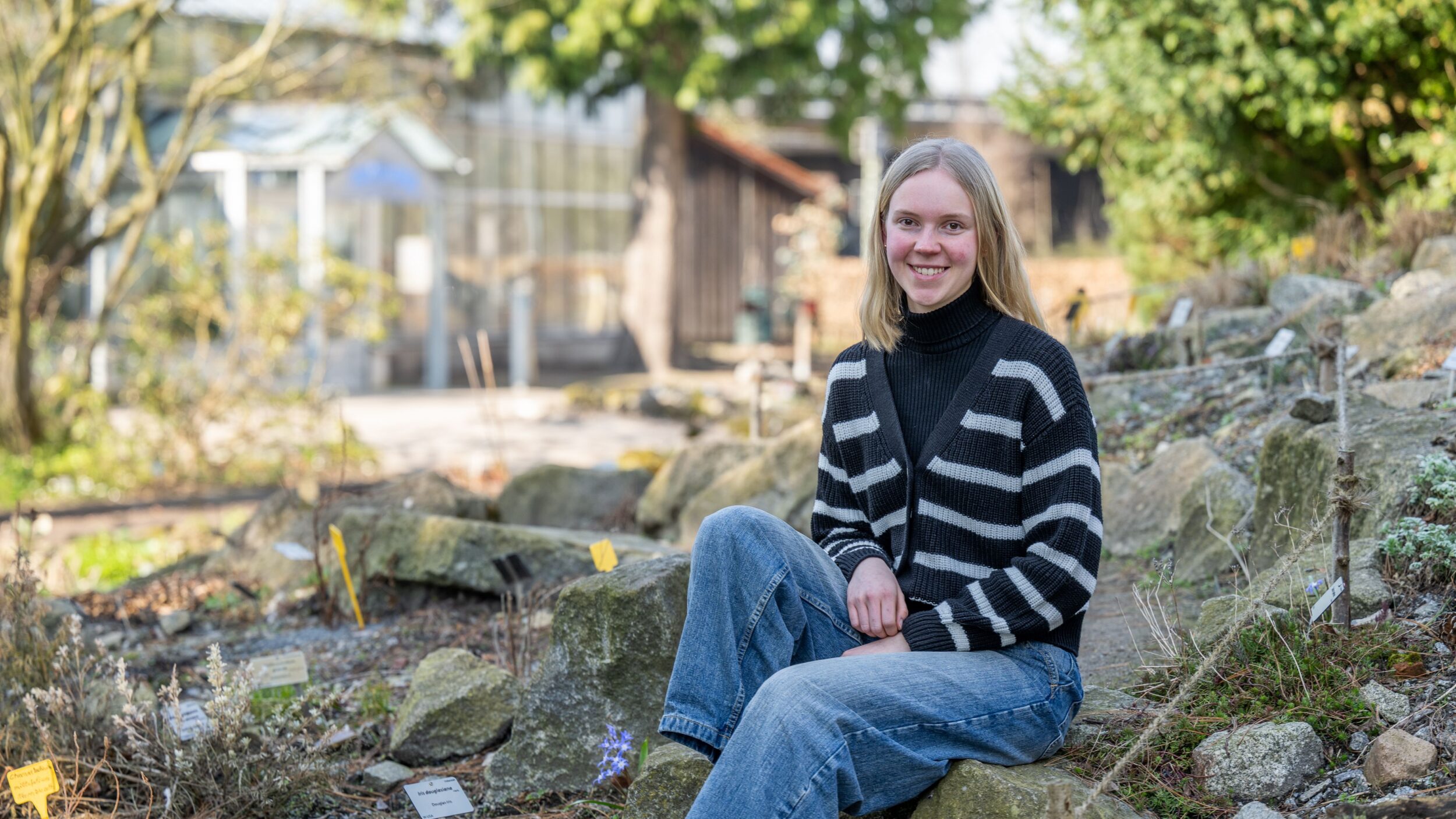

Melina Kramer is pursuing her teaching degree in two different subjects – biology and geography – at two different universities, Oldenburg and Bremen. This puts her organisational skills to the test, but she would “make the very same choice all over again”.
Years before she finished school, Melina Kramer, now 22, already knew what was next on her agenda: “I wanted to do a teaching degree in Oldenburg.” She had heard many good things about the university from friends of her older siblings and had already decided on her first teaching subject: biology. So far, so good.
As the deadline for university applications approached, Melina pondered on what to take as her second teaching subject and finally decided on geography – only to discover that it wasn’t on offer at her university of choice. She applied to several other universities in Lower Saxony, was accepted everywhere, but in the end chose Oldenburg, where the combination with geography was, after all, possible – thanks to the cooperation with the University of Bremen.
Since 2015, student teachers at the University of Oldenburg have had the option to study French, Spanish and Geography in Bremen, while those at the University of Bremen can take Dutch Studies, Slavic Studies or “Material Culture: Textiles” in Oldenburg. Both Universities of took the first steps towards offering such complements back in 2001.
A wide range of additional subject combinations
For future teachers, the cooperative study programme opens up a wide range of additional subject combinations which thus complement the courses offered by each university individually. The downside of this versatility is that neither the overall course structure nor the timetables of individual modules can be fully coordinated – that would be an impossible task.
“This means a lot of additional organising for students but also a lot chances,” explains Max-Simon Gündert, who has been coordinator of the cooperative study programme at the University of Oldenburg’s Centre for Teacher Education (DiZ) for just over a year now. He deals with general queries and directs students with more specific concerns to relevant sources of information or contact persons, both within the degree programmes or at the Bremen counterpart of the DiZ, the Centre for Teacher Education and Educational Research.
When she started her studies in 2023, Melina Kramer also soon realised that studying at two universities on campuses that are more than an hour’s bus and train journey apart requires a great deal of discipline, a strong support network among fellow students and the courage to skip the odd lesson.
“In my first semester I was a bit baffled by the different course structures for Biology and Geography. In both subjects, students were initially supposed to take more modules from the other subject, but if I’d only taken the modules specified for each subject, I would have fallen a third short of the standard 30 credits per semester,” she explains. “As a first-semester student I didn’t realise this at first, but luckily other students from the student council helped me with my timetable.”
Then in the following semester Melina had to come up with a solution to the problem of compulsory classes taking place at the same time on both campuses: She simply enrolled in both, attending the one in Oldenburg one week and the one in Bremen the next, and working hard to catch up on anything she missed. “It probably wouldn’t have worked out without my two groups of friends,” she says today. “But I passed everything and actually did really well. We all help each other out.”
Luckily for Melina, she had met two other freshers who were also taking Geography as a second subject right during orientation week in Oldenburg, and they explored the Bremen university campus together. This group has grown, and they now often meet on the train, as well as at seminars and lectures in Bremen. “In Oldenburg, we study different subjects – German, English, maths, PE… or biology like myself,” Melina explains.
According to student statistics from the University of Oldenburg’s Academic Controlling department, there are currently 196 joint-degree students, among them more than 150 with Oldenburg as their “home university”, while the remaining students are enrolled at the University of Bremen. In total, 146 teachers have graduated from the University of Oldenburg alone between 2015 and 2025 with their „Master of Education” degree after having studied at both the Universities of Oldenburg and Bremen. “The cooperative degree programme forces you to be well organised, to cooperate and to build up a network,” Melina observes.
She has got into the habit of using the time on the train to Oldenburg or Bremen to study – whether it’s reviewing seminar material or preparing for exams. “Some of my friends might wait until three weeks before an exam to start organising their materials and writing revision notes – that wouldn’t work for me,” says Melina. There have been times when she had two exams on the same day at two different locations. But that hasn’t been a problem so far, as in Bremen some exams take place in the late afternoon.
Melina enjoys having friends at both study locations and experiencing two different campus cultures. “I find the two universities quite different from each other,” she says. “On Wechloy campus in Oldenburg we spend a lot of time outdoors. The campus in Bremen isn’t as green as the one in Wechloy, so we tend to sit in the canteen or cafeteria. I like the strong practical focus in Oldenburg, also in teaching methodology.” This fits in well with her job as a student assistant at the Green School in Oldenburg’s Botanical Garden. “In Bremen, on the other hand, the geography department is a very close-knit community. With no more than 60 people in the lectures, many lecturers know you by name,” she observes.
In Melina’s view, the joint degree programme is definitely worth the extra organisational effort. “I simply love my subjects!” she enthuses. “And I’d make the very same choice all over again.”
About Teacher Education within the Northwest Alliance
Teacher education clearly plays a key role at the University of Oldenburg: When the university was founded in 1973, Oldenburg could already look back on 180 years of teacher training. In the previous decades, this had taken place at the Pädagogische Hochschule, which then became part of the university, and some of whose modernised buildings are still stand on the university campus. Today, the University of Oldenburg is the only higher education institution in Lower Saxony that offers research-based, practice-oriented teacher education for all types of schools. More than 41 percent of Oldenburg’s students are studying for a teaching degree, and almost 51 percent of its master’s degrees are awarded to future teachers.
Teacher education has high priority both for the University of Bremen and its wider community. All of the university’s faculties, with the exception of the faculty of law, are involved in the teacher education programmes. At 13 percent, student teachers make up a significant proportion of the student body. They are trained on the basis of the latest scientific findings in their chosen subjects, subject-specific didactics and educational science, thereby contributing to the development of school education and schools in the state of Bremen.
Contact:
Max-Simon Gündert
Centre for Teaching-Training – Didactic Centre (DiZ) at the University of Oldenburg
Phone: +49 441 798 3031
Mail: koop.hb-ol@uol.de