
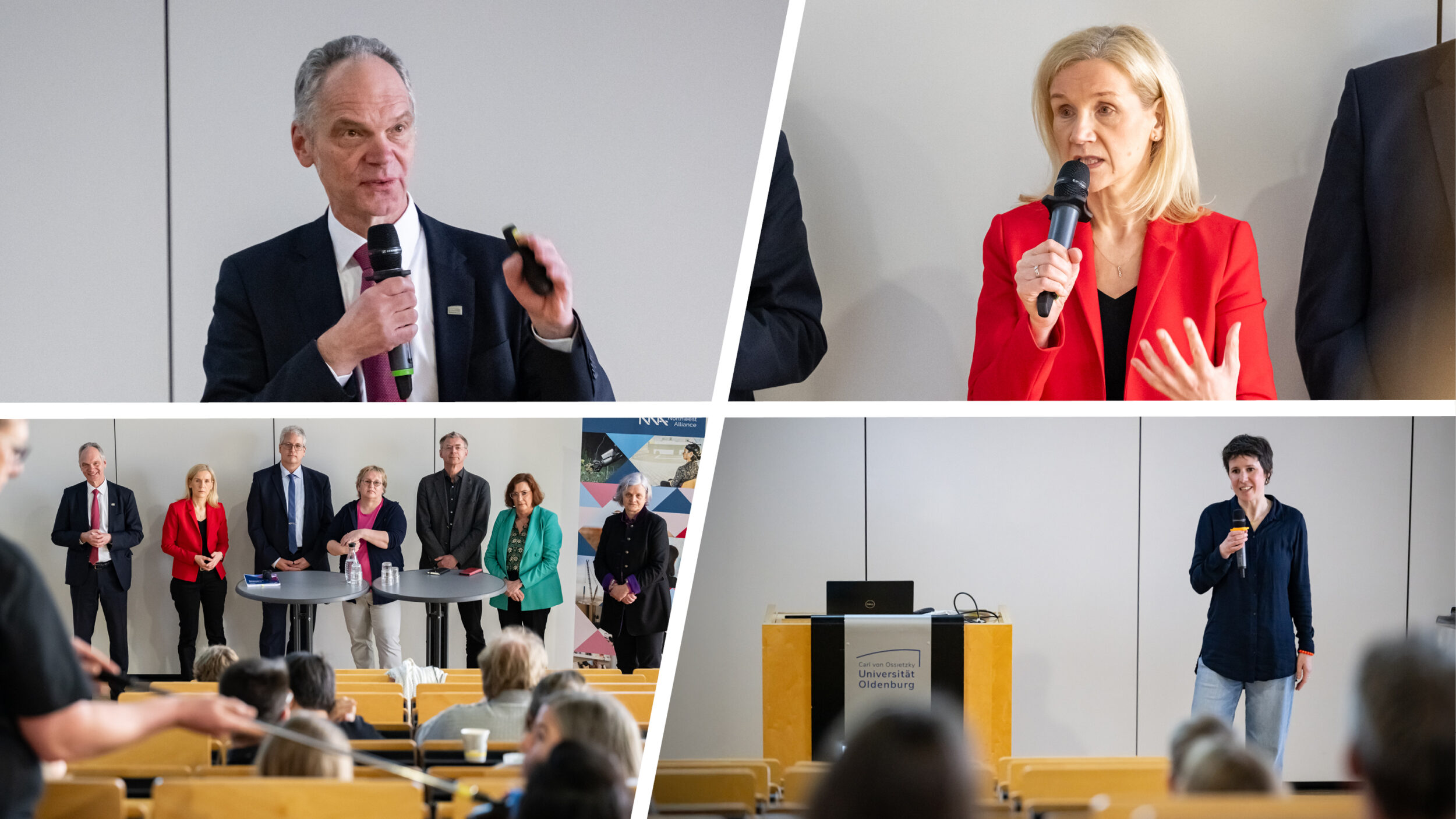

Two weeks before the on-site review by a panel of experts from the German Council of Science and Humanities, the Presidential Board of the University of Oldenburg and the Executive Board of the University of Bremen have held an event to provide staff and students at the two universities with details about the visit.
April 28 and 29 will probably be the most important dates of the year for the Universities of Bremen and Oldenburg: on these two days, around 20 evaluators commissioned by the German Council of Science and Humanities will visit the Bremen campus to review the two universities’ joint proposal for University Excellence Consortium status on site.
The University of Oldenburg and the University of Bremen submitted their joint University Excellence Consortium application to the German Council of Science and Humanities in November 2025 under the title “Northwest Alliance: Connecting for Tomorrow”. The aim is to further develop northwestern Germany as a vibrant scientific region where cutting-edge research and social responsibility go hand in hand.
Together with colleagues from the Presidential Board and the Executive Board, respectively, Professor Ralph Bruder, President of the University of Oldenburg, and Professor Jutta Günther, President of the University of Bremen, presented the strategy behind the Northwest Alliance’s proposal and explained how the on-site visit will be conducted and what the next steps will be. Interested parties from both universities were invited to attend the event which was moderated by Nele Claus from the Oldenburg Press & Communication office. They could ask questions, either in person at the Oldenburg Lecture Center or via livestream.
“Both universities were founded as ‘reform universities’, with a mandate to contribute to societal change processes. It is therefore of the utmost importance to us to combine academic excellence with societal impact – this is the goal we are setting out to achieve,” President Bruder explained.
“The quest for Excellence status is not an end in itself for us. Our aim is to explore the profound societal, cultural and technological upheavals of our time and to offer concrete solutions – in collaboration with the University of Groningen, the many non-university institutions in our network, and – as a key factor for us – the societal stakeholders,” emphasized President Günther.
The German Council of Science and Humanities will announce on 2 October which universities and university consortia will receive funding for seven years from January 2027 under the federal and state governments’ Excellence Strategy funding line.