

Researchers from Oldenburg and Bremen aim to make the Northwest more visible on the quantum physics map. Together with partners from Aachen and Hamburg, they recently established a “node” of an international research network.
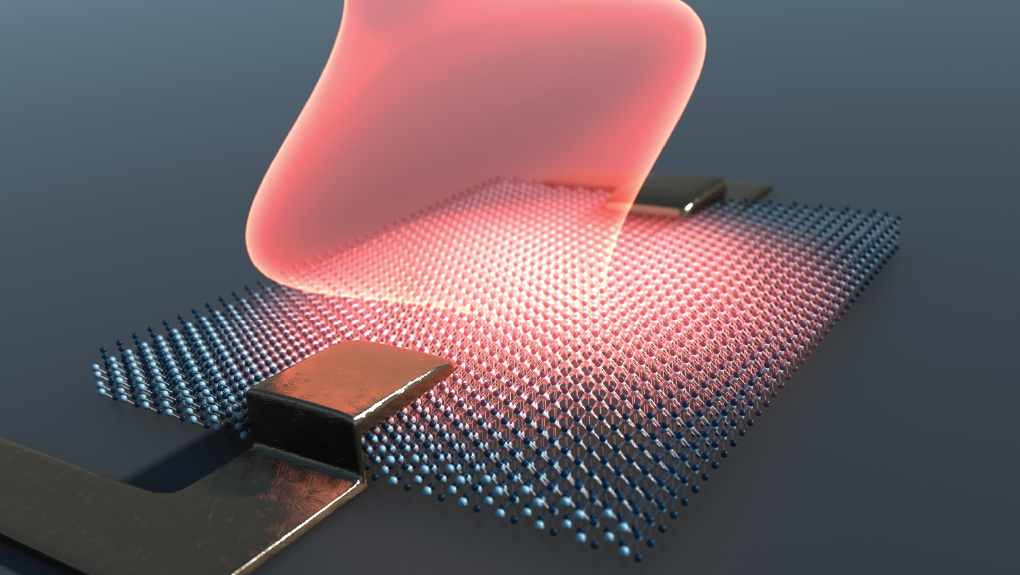
Quantum materials are solids and substances whose properties can be altered at the atomic level using light. These materials obey the peculiar laws of quantum physics. These unusual substances include superconductors, which conduct electrical current with almost no resistance, and wafer-thin crystals consisting of only a few atomic layers that react differently to light than bulk solids do. “These components could be used in optical data transmission or in quantum neural networks, and they could become as important as semiconductors are to today’s electronics,” explains Prof. Dr Christopher Gies, a quantum theory professor at the University of Oldenburg.
The unusual properties of these promising materials are being studied at the University of Bremen’s Faculty of Physics and the University of Oldenburg’s Institute of Physics. In late 2025, Gies; Prof. Dr Michael Sentef and Prof. Dr Lucio Colombi Ciacchi, both from Bremen; Prof. Dr Dante Kennes from RWTH Aachen University; and Prof. Dr Angel Rubio from the Max Planck Institute for the Structure and Dynamics of Matter in Hamburg established a “node” within the international research network Centre Européen de Calcul Atomique et Moléculaire (CECAM). The new CECAM node, “Quantum Material Dynamics” (QMDYN), is one of four German nodes and one of 21 thematic nodes in the network. Participants organize workshops, tutorials, summer schools, and other exchange formats focused on their respective areas. They also support networking, the further development of the community, and joint research projects.
“The focus of our node is on better understanding the dynamic world of quantum materials and making it computationally accessible,” explains Bremen-based physicist Michael Sentef, who coordinates the activities as director. The researchers aim to simulate how materials react to extremely strong laser fields and how unusual particles, which possess properties of both light and matter, can be generated.
The focus is on computer simulations of quantum physical phenomena
“Our goal is to build a community to advance research in our field,” explains Gies. “Our focus is on computer simulations of quantum physical phenomena in solids that occur extremely rapidly or in which the participating particles interact very strongly with one another. Here, we are also relying on new methods, such as quantum machine learning and the use of quantum computers.”
The CECAM organization is supported by various national research funding agencies and is based in Lausanne, Switzerland. Since 1969, the network has been dedicated to developing powerful computational methods to investigate the physics and chemistry of solids. Thanks to major advances in IT hardware and software, the participants’ interests now extend far beyond atoms and molecules to challenging problems in materials science, biology, and medical chemistry.
Expanding international activities
The QMDYN node’s first high-profile workshop took place in February at the House of Science in Bremen. Prof. Dr Michal Kucera, a vice president at the University of Bremen, welcomed the participants and encouraged them to expand the network’s international activities. Christopher Gies found the meeting highly interesting in terms of content and a perfect networking opportunity: „For us researchers from Oldenburg and Bremen, the workshop was a great opportunity to come together and develop shared ideas and perspectives.”