

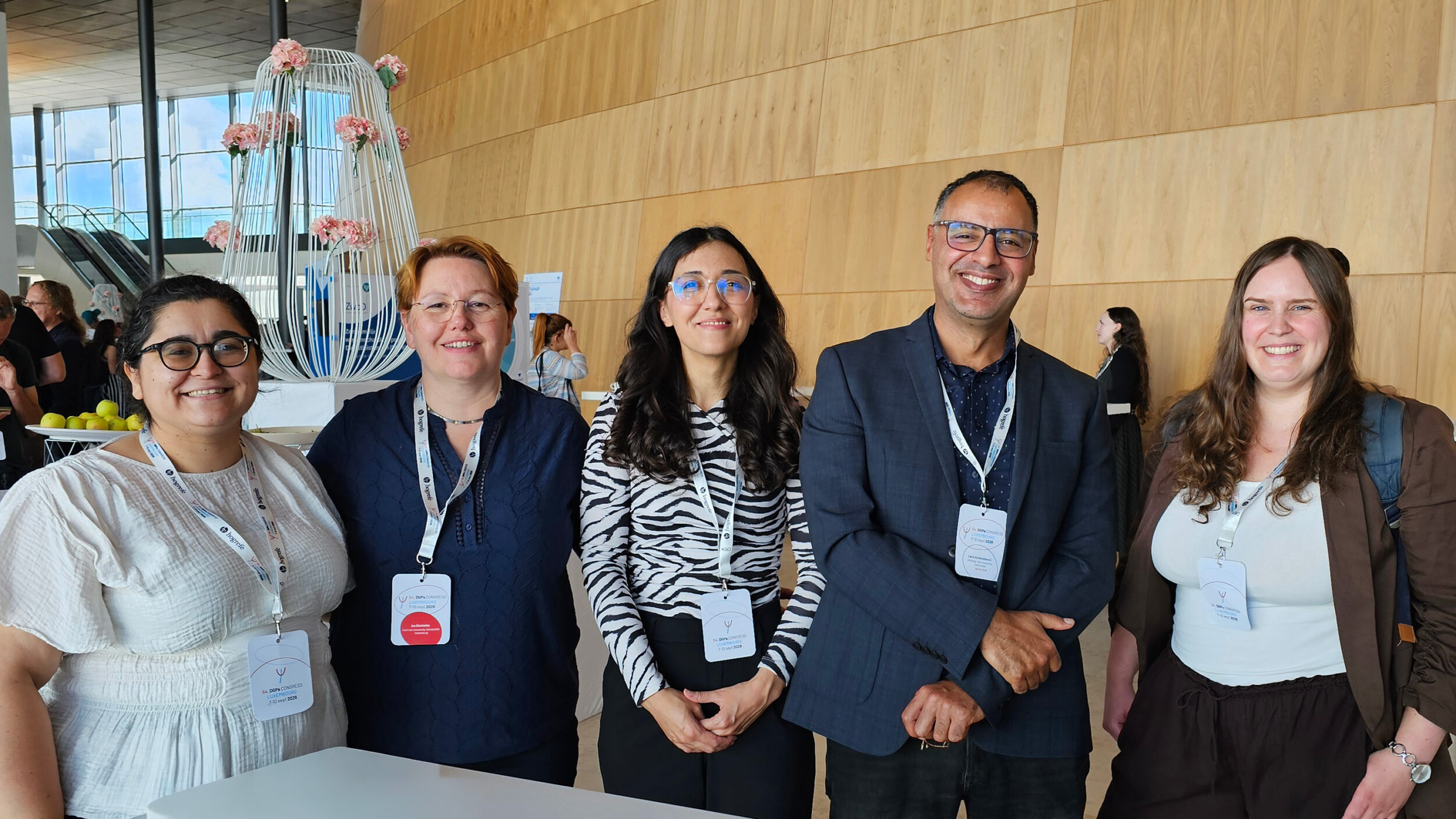

From September 7 to 10, around 2,000 researchers from around the world gathered at the 2026 Congress of the German Psychological Society (DGP). The event featured a symposium by researchers from the University of Bremen and the University of Oldenburg, who presented their work on AI and children.
Under the theme “Attitude. Diversity. Future,” conference participants exchanged ideas on topics including mental health, digital transformation and AI, and the psychology of sustainable behavior.
At the joint symposium entitled “Artificial Intelligence and Children – Mapping the Digital Transformation with Multiple Methods,” the researchers presented findings from various disciplines, including psychology and computer science education in order to explore how children interact with AI.
University of Bremen: How Families Perceive Robots and Interact with AI
Two presentations from the Department of Developmental and Educational Psychology, headed by Professor Louisa Kulke, addressed how people interact with AI and robots. Niloofar Goharbakhsh, a research assistant in the department, investigated interactions between children and robots. Using eye tracking, she observed how children reacted when robots were excluded from a group and what role the robots’ physical resemblance to humans played in these reactions.
Professor Kulke also presented her research findings on human-robot interaction. Her experiments showed that participants sitting with robots and humans in a waiting room, maintained eye contact with the robots significantly longer than with the humans. These results suggest that people do not automatically apply implicit social rules to their interactions with robots.
Sahura Ertuğrul, a research assistant in the Department of Developmental and Educational Psychology, presented her research on how parents and children interact with AI. Through qualitative interviews, she examined parents’ knowledge and habits regarding AI, as well as how they perceive and regulate their children’s use of it. Her findings show how parents cope with the challenge of teaching their children to use a technology with which they themselves are still unfamiliar.
University of Oldenburg: Use of AI in Schools
Ira Diethelm, a professor of computer science education at the University of Oldenburg, focuses her research on the use of AI in elementary schools. She believes that children should not only use digital technologies but also understand and help shape them. At the symposium, Diethelm presented the IT2School project, which was jointly developed by the University of Oldenburg and the affiliated OFFIS institute. IT2School offers teaching materials on digital technologies, including AI. These materials have already been used in more than 1,000 schools.
Dr. Larbi Abdenebaoui, head of the Human-Centered AI Group and senior researcher at OFFIS, an affiliated institute of the University of Oldenburg, and Susanne Boll, a professor of media informatics and multimedia systems at the University of Oldenburg, presented the AI-supported tutoring module EduMind. They are developing EduMind as part of a joint project. The module provides personalized, real-life explanations tailored to learners’ interests and combines them with teachers’ expertise.
“The joint session demonstrated how the expertise of the University of Oldenburg and the University of Bremen complements each other in this field,” said Louisa Kulke, who organized the symposium. “The event also sparked new ideas for collaborative studies between Bremen and Oldenburg aimed at providing academic support for children navigating the digital transformation.”