

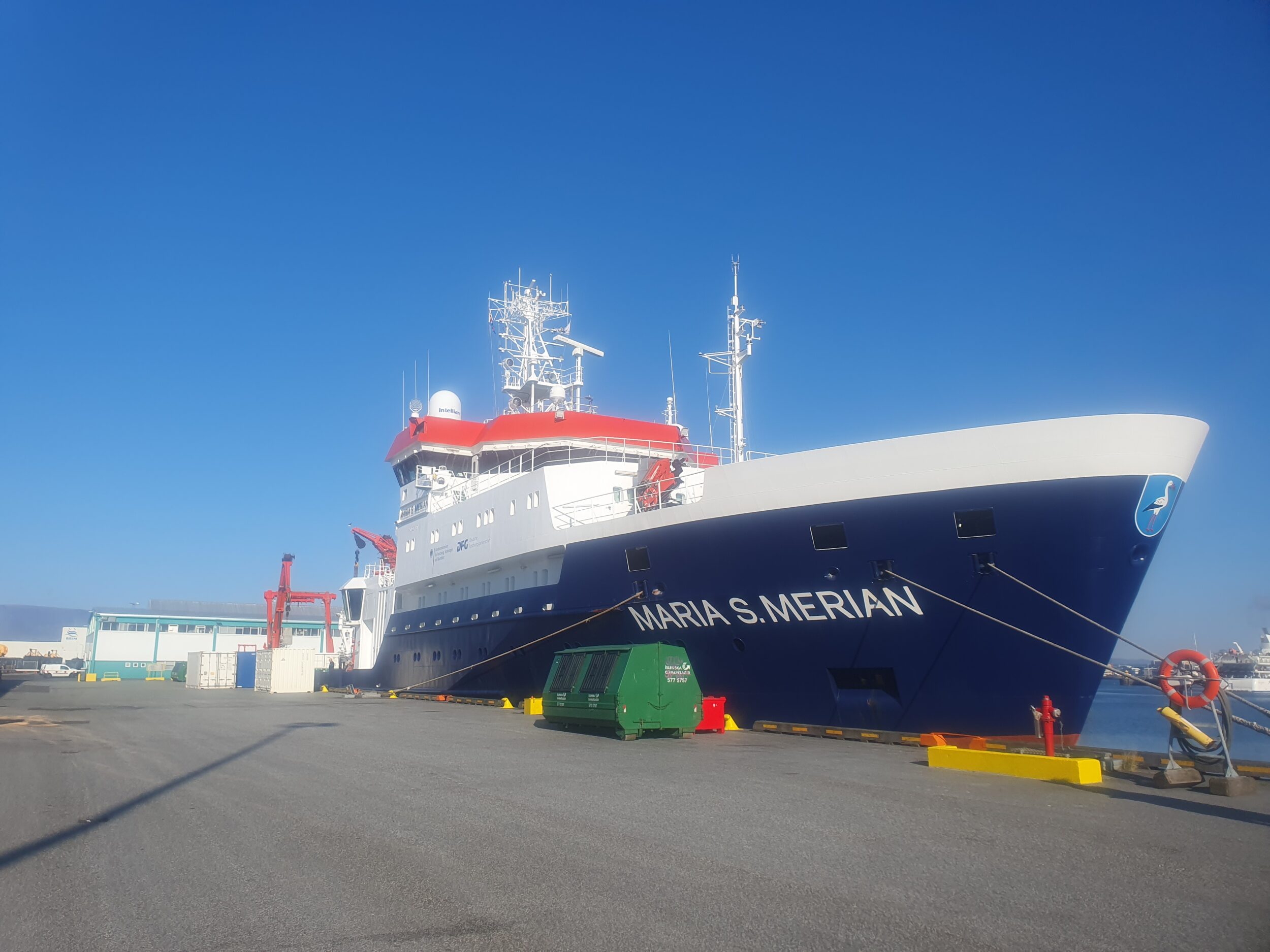

How are rising global temperatures changing the Arctic? That question is at the center of an expedition to Baffin Bay, between Greenland and Canada, aboard the research vessel MARIA S. MERIAN. Dr. Miriam Römer of MARUM – Center for Marine Environmental Sciences at the University of Bremen is the expedition’s chief scientist.
A warmer climate is not only causing the polar sea ice to melt, but higher temperatures are also directly affecting the carbon cycle. As a result, the goal of the expedition is to investigate sources, reservoirs, and sinks of hydrocarbons in Baffin Bay that are sensitive to changing global temperatures. The researchers also want to find out under what conditions naturally occurring oil and gas are released in the Arctic.
Gas hydrates are another focus of the expedition. These are solid, ice-like compounds made of methane and water that occur in marine sediments and remain stable only at low temperatures and high pressures. Part of the research team will also study phytoplankton, which uses light near the sea surface to produce organic matter and forms the basis of the marine food web.
The expedition, carried out by an interdisciplinary, international team of experts in marine geology, geochemistry, and microbiology, began on August 19. In addition to researchers from Bremen, the team includes a group from the University of Oldenburg as well as experts from Canada, Sweden, and Norway. The researchers will locate current sites of gas and oil discharge, record their composition and flow rates, and assess microbial turnover at rising temperatures. The technologies used include echo sounders, the ROV MARUM-SQUID, gravity cores, multicorer, a CTD rosette system, a greenhouse gas analyzer, a surface oil sampling system, and drones.
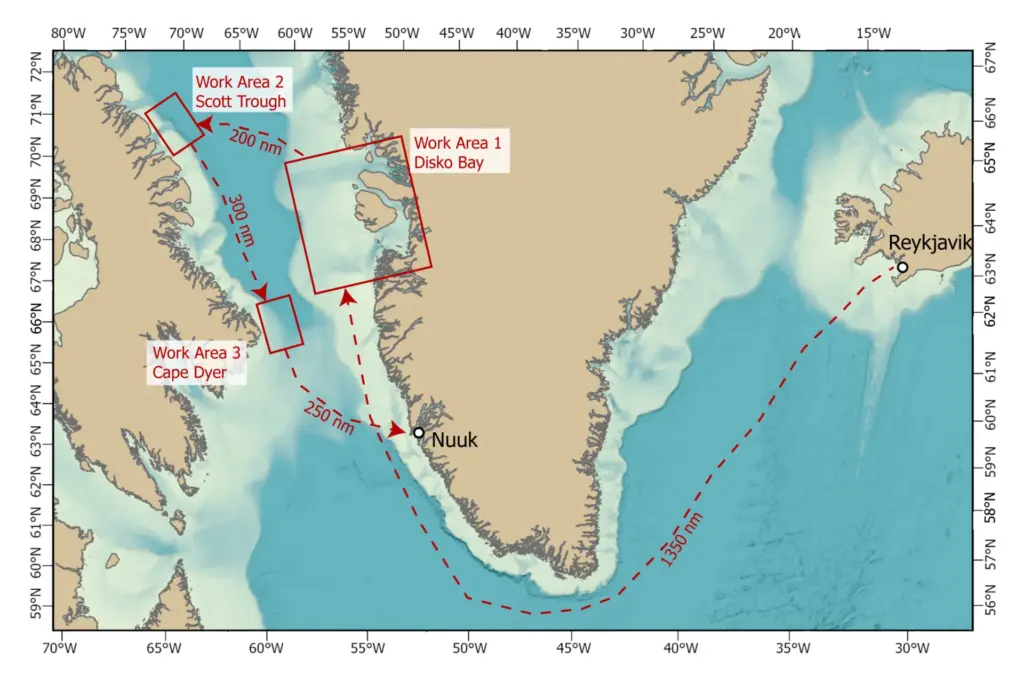
The expedition is an exploratory voyage: the team’s first priority is to get an overview of the extent of the deposits present. In a follow-up expedition as part of the “The Ocean Floor” Cluster of Excellence, the researchers plan to collect additional data in a targeted manner and analyze it qualitatively.
MARUM is also participating in the upcoming MSM146/2 expedition, alongside GEOMAR Helmholtz Center for Ocean Research Kiel and the German Alliance for Marine Research (Deutsche Allianz Meeresforschung, DAM). The goal of the expedition is to map the ocean floor in detail, with a particular focus on so-called seamounts.
The researchers aboard the MSM 146, en route from Reykjavik (Iceland) to Nuuk (Greenland), are keeping a logbook detailing life and work on board.
Participating Scientific Institutions
- MARUM – Center for Marine Environmental Sciences and the Faculty of Geosciences at the University of Bremen
- Institute for Chemistry and Biology of the Marine Environment (ICBM), University of Oldenburg
- Faculty of Science, Department of Biological Sciences, University of Calgary (Canada)
- Department of Geological Sciences, Stockholm University (Schweden)
- The University Centre in Svalbard (Norwegen)