


The coming into force of the UN High Seas Treaty in January raises many questions. One particularly pressing issue is where protected areas should be established by 2030. Researchers from the universities of Oldenburg and Bremen are jointly investigating this in the AGELESS project.
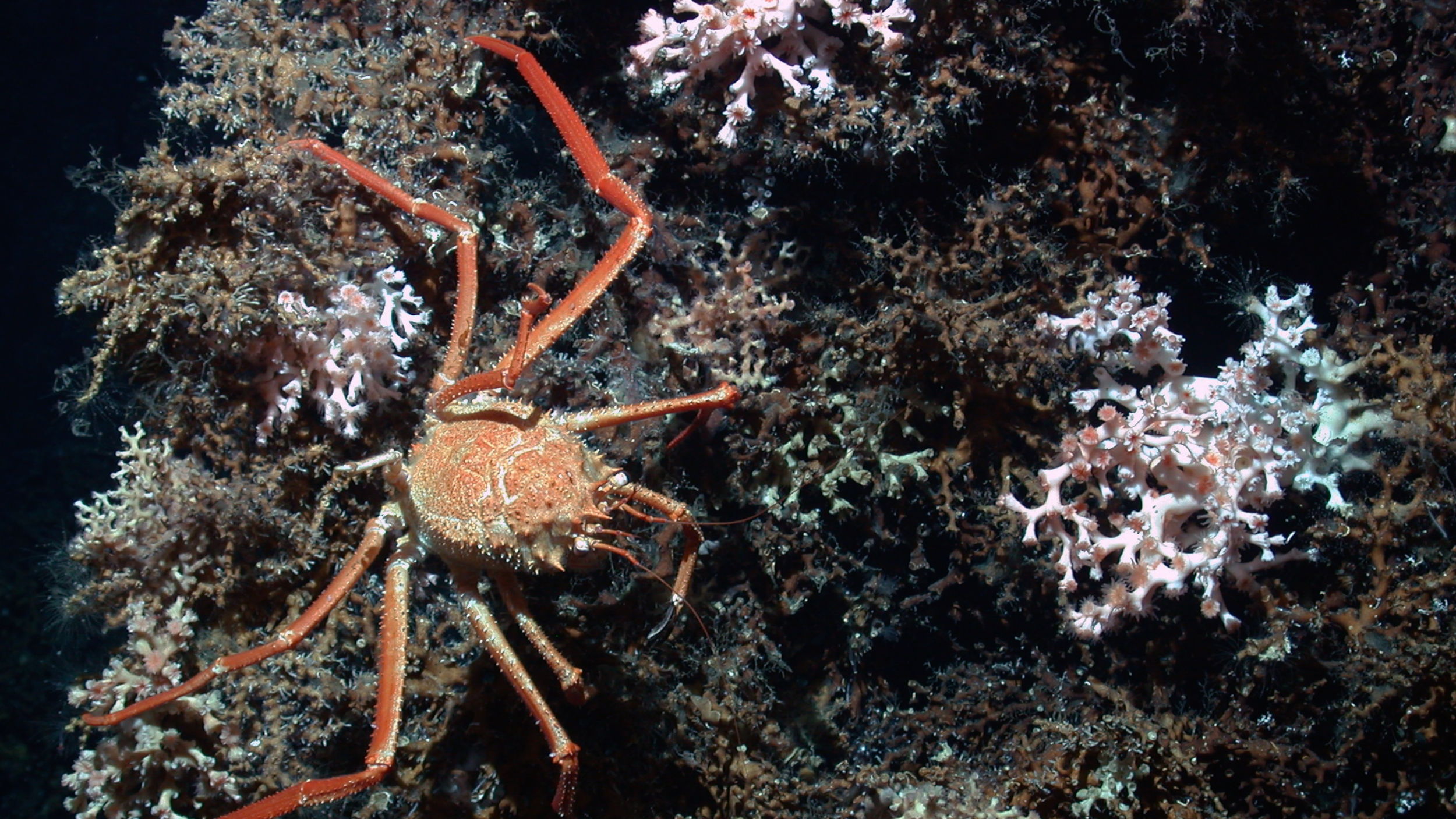
In the middle of the Atlantic Ocean between Iceland and the Azores, at roughly the same latitude as Oldenburg and Bremen, lies a special area: the Charlie Gibbs Marine Protected Area, about half the size of Germany and home to blue whales, leatherback turtles, rare deep-sea sharks, and colonies of cold-water corals.
What makes this protected area so special is not only its rich biodiversity, but also the fact that it is located in international waters – one of only a few marine protected areas worldwide. The high seas, or more precisely “areas beyond national jurisdiction,” account for around 40 percent of the Earth’s surface. But only 1.5 percent of this area is officially protected.
That is now set to change. On January 17, the UN High Seas Treaty came into force. “With this treaty, there is now a legal framework for this part of the oceans for the first time,” explains Oldenburg-based marine biodiversity expert Dr. Jan-Claas Dajka. Until now, there have been no binding rules governing the use of resources on the high seas. “A Wild West situation,” is how the researcher from the Helmholtz Institute for Functional Marine Biodiversity at the University of Oldenburg (HIFMB) describes it.
The aim is for 30 per cent of international waters to be under protection by 2030
By the beginning of March, 86 countries had ratified the agreement, meaning they had made into national law. In 60 other countries, including Germany, the process is still ongoing. The framework for high seas protection is clear: among other things, the countries have set themselves the goal of protecting 30 percent of international waters by 2030. In protected areas, human activities such as fishing, shipping, and deep-sea mining could be restricted. Furthermore, potentially harmful activities are to be subject to an environmental impact assessment, and the benefits of genetic resources should be distributed fairly among all countries.
However, many details of the agreement are still unclear and must now be clarified in just three and a half years: Where should protected areas be located? What criteria will be used to establish them? Who will monitor compliance with the rules? What happens in the event of disputes? The AGELESS project (Leveraging long-term planktonic diversity data to develop a framework to assess and protect biodiversity in areas beyond national jurisdiction), funded by the Federal Ministry of Research, Technology and Space (BMFTR), focuses primarily on the first two questions. In the project, researchers from the University of Bremen are working closely with scientists from Oldenburg from both the HIFMB and the local university. The project is coordinated by Prof. Dr. Michal Kucera and Dr. Lukas Jonkers from the University of Bremen.
The AGELESS team aims to gain a better understanding of the changes in marine biodiversity caused by climate change and to develop specific recommendations for improving the protection of marine biodiversity.
Marine Ecosystems are Shifting Due to Climate Change
A key question the team is investigating is: Will biologically significant communities such as those in the Charlie Gibbs area still be in the same place in a few decades? After all, climate change is altering seawater temperatures, currents, nutrient supply, and other living conditions. “These changes must be taken into account in conservation concepts,” emphasizes Dajka.
The starting point for answering this question is provided by some of the smallest sea creatures – plankton communities. The researchers are studying the fossils of single-celled organisms that have been deposited on the sea floor. Sediment cores can be used to establish time series on the composition of plankton communities dating back as far as 65 million years. This allows the team to investigate how plankton reacted to previous climate changes and draw conclusions about changes in biodiversity as a whole. “We are paying particular attention to the last 130,000 years – the last ice age and the preceding interglacial (warm) period – to see whether there were environmental situations during this time that we can expect in the future,” explains project coordinator Lukas Jonkers, paleoceanographer at MARUM – Center for Marine Environmental Sciences at the University of Bremen.
The team is also looking at modern communities of single-celled organisms. “It is important to understand the mechanisms underlying changes in biodiversity,” Jonkers emphasizes. Using simulations, the researchers are investigating how climate change affects the higher levels of the food web – for example, whales, sharks, corals, and squids. Prof. Dr. Bernd Blasius, a modeler from Oldenburg, is developing corresponding computer models.
Dialogue with Stakeholders and Development of Action Recommendations
What these findings mean for the designation of protected areas, for example, is the subject of a dialogue with stakeholders, ranging from federal authorities to industry associations and non-governmental organizations. To this end, a team led by Dajka, Oldenburg marine expert Prof. Dr. Helmut Hillebrand, and environmental economist Prof. Dr. Bernd Siebenhüner are in close collaboration with stakeholders, building a common knowledge base that includes the most important project results for policymakers.
In addition, the researchers have established a dialogue with experts from Germany’s Federal Agency for Nature Conservation, Federal Ministry for the Environment, Federal Maritime and Hydrographic Agency, and environmental and fisheries associations. The aim is to jointly draft recommendations for action that consider both the interests of the stakeholders and the scientific findings.
In doing so, the team is building on the social science research carried out in the project. “We are looking at which management concepts are suitable for protecting biodiversity in the high seas, and we are investigating how so-called science-policy interfaces, namely committees made up of representatives from science and politics, should be designed within the framework of the UN High Seas Treaty,” explains Dr. Torsten Grothmann from the Oldenburg Ecological Economics research group. Another goal is to incorporate the recommendations developed in the project into international regulations governing protected areas. The first conference of the countries that signed the treaty is to take place within one year of the High Seas Treaty coming into force.
If we can convince stakeholders that it is important to consider climate change when designating protected areas, we will have already achieved a great deal.
Lukas Jonkers, paleoceanographer
“Interaction with stakeholders is progressing well,” reports project coordinator Jonkers. A workshop with the participants will take place in Berlin in May, after which the team will present the results to members of the German Bundestag. Another dialogue forum is planned for 2027. “It is very positive that all stakeholders are willing to sit down together to make constructive progress; the atmosphere of the discussions is very cooperative,” reports Jan-Claas Dajka, based on his experience so far.
For natural scientist Lukas Jonkers, the project is particularly exciting because of its strong practical relevance and close collaboration with Oldenburg researchers from the social sciences – even if it is not always easy: “The biggest challenge at first was finding a common language,” he reports. At the same time, both sides are able to learn a lot from each other and achieve a great deal together. Jonkers’ hope: “If we can convince stakeholders that it is important to consider climate change when designating protected areas, we will have already achieved a great deal.”