

The University of Bremen and the University of Oldenburg work together to combine their strengths and operate research infrastructure at the highest level. This long-standing collaboration provides national and international researchers with easy access to modern infrastructure, today and in the future.
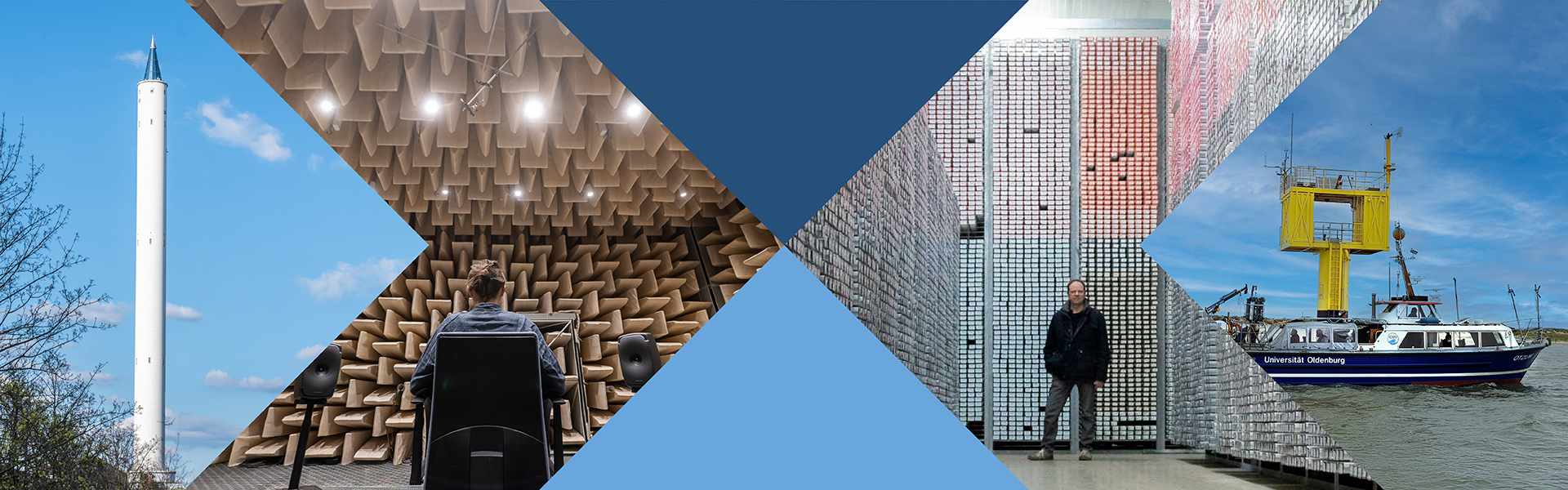
Since 1990, the Center of Applied Space Technology and Microgravity (ZARM) has provided researchers with the opportunity to carry out short-term experiments under microgravity conditions in its 146-meter Drop Tower. A test capsule is either pulled up and dropped into the approximately 120-meter-high, airless drop tube or it is shot up to below the top of the drop tube with the unique catapult system and caught again. Experiments are carried out up to three times a day in a weightless environment with just one millionth of the Earth’s gravitational force.
Covering a total area of 2,000 square meters, the NeSSy Research Building (Neuro-Sensory and Safety-Critical Systems) houses state-of-the-art laboratories specializing in acoustics, neurophysiology, and virtual reality, as well as advanced large-scale equipment such as magnetoencephalography and functional magnetic resonance imaging. NeSSy is home to a variety of interdisciplinary initiatives and provides researchers with the necessary space and equipment to conduct studies in the fields of hearing research, medical technology, and human-machine interaction.
MARUM – Center for Marine Environmental Sciences is currently home to one of three international core repositories of the „International Ocean Drilling Programme (IODP³).“ The Bremen core repository currently holds over 193 kilometers of cores from several geological eras and from 106 expeditions – including material from the Atlantic, the Arctic Ocean, the Mediterranean, the Black Sea, and the Baltic Sea. Around 200 scientists work in the Bremen repository every year and more than 50,000 samples are removed from the cores annually.
The MARUM-QUEST 5000 submersible robot is used on research vessels worldwide for scientific sampling and data collection in the deep sea. It has been in operation as a successor to the MARUM-QUEST 4000 since 2025, offering a higher payload capacity, improved data transmission, more powerful hydraulics, and a dive depth of up to 5,000 meters. Its predecessor completed 490 dives on over 42 expeditions beginning in 2003.
Set amid the UNESCO World Natural Heritage Site of the Wadden Sea, the world’s largest tidal flat region, the back-barrier island of Spiekeroog is an ideal location for the Spiekeroog Coastal Observatory (SCO), which focuses on land-sea interactions. At the heart of the observatory lies the Spiekeroog Time-Series Station (TSS), situated in a tidal channel near the island. The station provides continuous long-term oceanographic, meteorological, and biogeochemical data. It supports cross-institutional research and teaching and is part of the Long-Term Ecosystem Research Network (LTER-D) and iLTER. In addition to the permanent station, several locations on the island and in the surrounding area house permanent or temporary sensors for environmental monitoring and campaign-based field research. Three different research boats are available for technical support and any kind of coastal research.
The MAPEX Core Facility serves as the central infrastructure for materials science at the University of Bremen. Internal and external researchers from various disciplines have access to a range of high-performance scientific equipment. This equipment can comprehensively determine the structure and chemical state of materials – from the atomic to the macroscopic level. The core facility bundles expertise and technical equipment in key areas including 3D material analysis, electron microscopy, surface analysis, and spectroscopy.
Realistic turbulent wind fields and wind speeds of up to 150 kilometers per hour can be generated in the turbulence wind tunnel. This state-of-the-art facility is one of the centerpieces of wind energy research in Oldenburg, located within the 2,300-square-meter Wind Lab on the Wechloy Campus. Utilizing the active grid in the tunnel, researchers can control and align more than 1,000 flaps to generate turbulence and wind gusts in a targeted way.
In the non-magnetic house, researchers can control magnetic fields with great precision regardless of their temporal or static properties. The building is a key facility for behavioral research into the navigational skills of birds and other animals in Oldenburg. The wooden house was constructed without the use of ferromagnetic materials, and has three rooms, each of which contains one or two electromagnetically shielded chambers. Application-specific research equipment is manufactured and maintained in the technical-scientific infrastructure operating unit.
The robotics laboratory resembles an apartment, complete with a kitchen and a dining area, that is used for research with robotic systems in a household-like environment. This lab setting allows researchers to examine many facets of human and robot movement sequences and problem-solving strategies relating to everyday domestic tasks. The robotics laboratory and the Virtual Research and Training Building (VRB) are among the leading AI-based robotics facilities in Europe.
A wide range of research groups, spanning the social sciences and theoretical physics, as well as additional external partners, make use of the advanced high-performance computing (HPC) facilities in Oldenburg. The HPC landscape is continuously updated and currently comprises the multi-purpose computing cluster ROSA, as well as the specialized STORM and MOUSE systems, which are used for applications in the field of computational fluid dynamics (CFD). The clusters have a total of approximately 20,600 computing cores and 145 terabytes of main memory. The total peak performance of the HPC systems is approximately 1.1 PFlops (CPU) and 2.0 PFlops (GPU). The Scientific Computing division provides expert support and advice, as well as a wide range of training and continuing education opportunities.